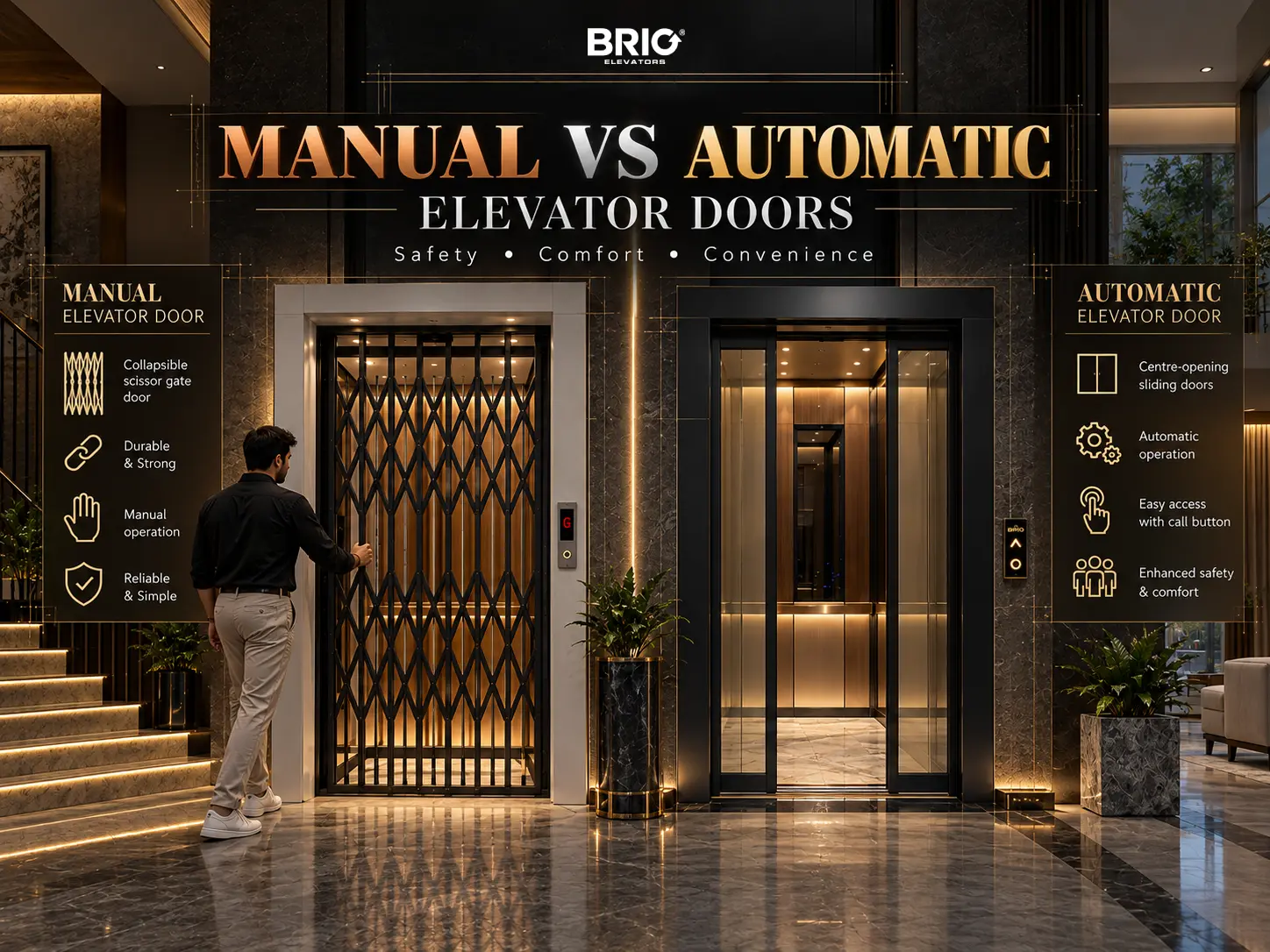
Home elevators should make everyday movement simple, comfortable, and safe for the whole family. While choosing an elevator, homeowners often focus on the cabin, technology, interiors, and price. The door system deserves equal attention.
Traditional elevators may use manual doors, including collapsible or grill-type gates that passengers have to open and close by hand. Modern elevators increasingly use automatic doors, which operate through the elevator control system.
From Brio Elevators' perspective, automatic doors are generally the better choice for modern homes because they reduce manual handling, improve accessibility, and can work with advanced safety systems such as sensors and light curtains.
This blog explains the difference in simple language and why Brio prefers a more automatic, safety-focused door experience for today's homes.
Manual doors must be physically opened and closed by the passenger.
Older elevator systems commonly use:
The passenger may need to open the door, enter the cabin, close the gate correctly, and make sure it is secured before the elevator moves.
The system can work when correctly designed and maintained, but it requires more involvement from the user during every trip.
Automatic doors open and close through the elevator control system.
When the elevator arrives, the doors open automatically. After passengers enter or exit, they close automatically.
Modern automatic door systems can include:
This reduces the need for passengers to physically handle the doors.
For modern home elevators, this can make everyday use much easier.
At Brio Elevators, the focus is on making residential elevator use simple for every generation of the family.
Automatic doors support this approach because they can offer:
For a family elevator, the fewer unnecessary actions a passenger needs to perform, the easier the experience becomes.
With a manual or grill-type door, the passenger is responsible for operating the door correctly.
This can involve several steps:
For an adult with both hands free, this may seem simple.
But it can become inconvenient for:
Automatic doors reduce much of this manual effort.
Traditional collapsible or grill doors contain several moving sections.
If the system is poorly maintained or used carelessly, there can be concerns such as:
A proper safety interlock and regular maintenance are essential in any manual-door elevator.
From a modern residential point of view, Brio prefers to reduce this level of direct passenger interaction where possible.
One of the advantages of modern Automatic doors is the ability to work with electronic safety systems.
A common feature is a light curtain.
A light curtain creates an invisible detection zone across the elevator entrance.
If a person, hand, bag, or other object is detected while the doors are closing, the system can respond according to its design, such as stopping or reopening.
This can be especially useful for:
This is one reason automatic doors are an important part of modern elevator safety.
For elderly family members, even opening a door repeatedly can become uncomfortable.
A manual door may require the user to hold, push, pull, or slide it while also maintaining balance.
Automatic doors reduce this effort.
The passenger can simply:
For Brio, this easier experience is important when designing elevators for multi-generation homes.
Automatic doors can also make elevator access easier for wheelchair users.
A wheelchair user does not have to approach the lift, reach for a door, operate it, and then reposition the wheelchair to enter.
Automatic opening can make the movement more direct.
However, accessibility should also include:
The complete elevator should be planned around the user.
A home elevator may be used many times each day.
Imagine using the lift while carrying:
With a manual door, the passenger still needs to operate the door.
With automatic doors, the elevator handles the opening and closing.
This small difference can make a big improvement in everyday comfort.
A home elevator is also part of the interior.
Traditional grill-type doors often have a more functional or older-style appearance.
Automatic sliding doors can provide a cleaner and more integrated look.
They can suit:
For Brio, design and convenience should work together rather than compete with each other.
Manual grill gates can produce sound from:
As the components age, regular maintenance becomes increasingly important.
Modern automatic doors use controlled opening and closing mechanisms.
When properly installed and serviced, they can provide smoother door movement and a more refined residential experience.
Whether a lift has manual or automatic doors, a proper door interlock is important.
The interlock helps ensure that the elevator moves only when the door is in the correct safe position.
Homeowners should ask:
Good elevator safety depends on the complete door and control system.
13. Maintenance Still Matters With Automatic Doors
Automatic doors provide greater convenience, but they still need professional maintenance.
Important components can include:
Regular servicing helps keep the doors operating smoothly and reliably.
At Brio, safety does not end with installation. Maintenance is an important part of long-term elevator performance.
A good home elevator should also be prepared for unexpected power interruptions.
Depending on the elevator model, modern systems can include:
Homeowners should understand how the elevator and its doors behave during a power failure before installation.
This is an important part of choosing any residential lift.
From Brio Elevators' perspective, automatic doors provide a better overall experience for most modern residential applications.
They can offer:
Manual doors can operate properly when correctly designed and maintained, but they depend more heavily on the passenger.
Automatic doors allow more of the process to be managed by the elevator itself.
At Brio Elevators, the goal is not simply to make an elevator look premium.
It should also feel simple and comfortable to use every day.
Brio focuses on door systems and safety features that can support:
For modern home elevators, automatic doors fit naturally with this approach.
Before selecting a home lift, ask:
These questions are more useful than choosing an elevator only by its cabin appearance.
Home elevators should make everyday movement easier, not add unnecessary effort.
Manual doors require more physical operation from passengers, while automatic doors provide easier access, greater convenience, and the ability to work with modern sensor-based safety systems.
For this reason, Brio Elevators sees automatic doors as the more practical choice for most modern family homes, especially where senior citizens, children, or people with mobility needs use the elevator regularly.
The right elevator should combine safety, comfort, accessibility, and simple everyday operation.
📞 Call: +91 9398113939 🌐 Visit: brioelevators.com
Frequently Asked Questions
Automatic doors reduce manual handling and provide easier, more convenient access for different family members.
Manual doors can operate safely when correctly designed and maintained, but they require more physical interaction and careful use.
They remove the need to physically open and close the elevator door, making entry and exit easier.
A light curtain detects people or objects in the doorway and helps the automatic door respond to an obstruction.
Check for door interlocks, obstruction detection, sensors, emergency operation, proper installation, and regular maintenance.

