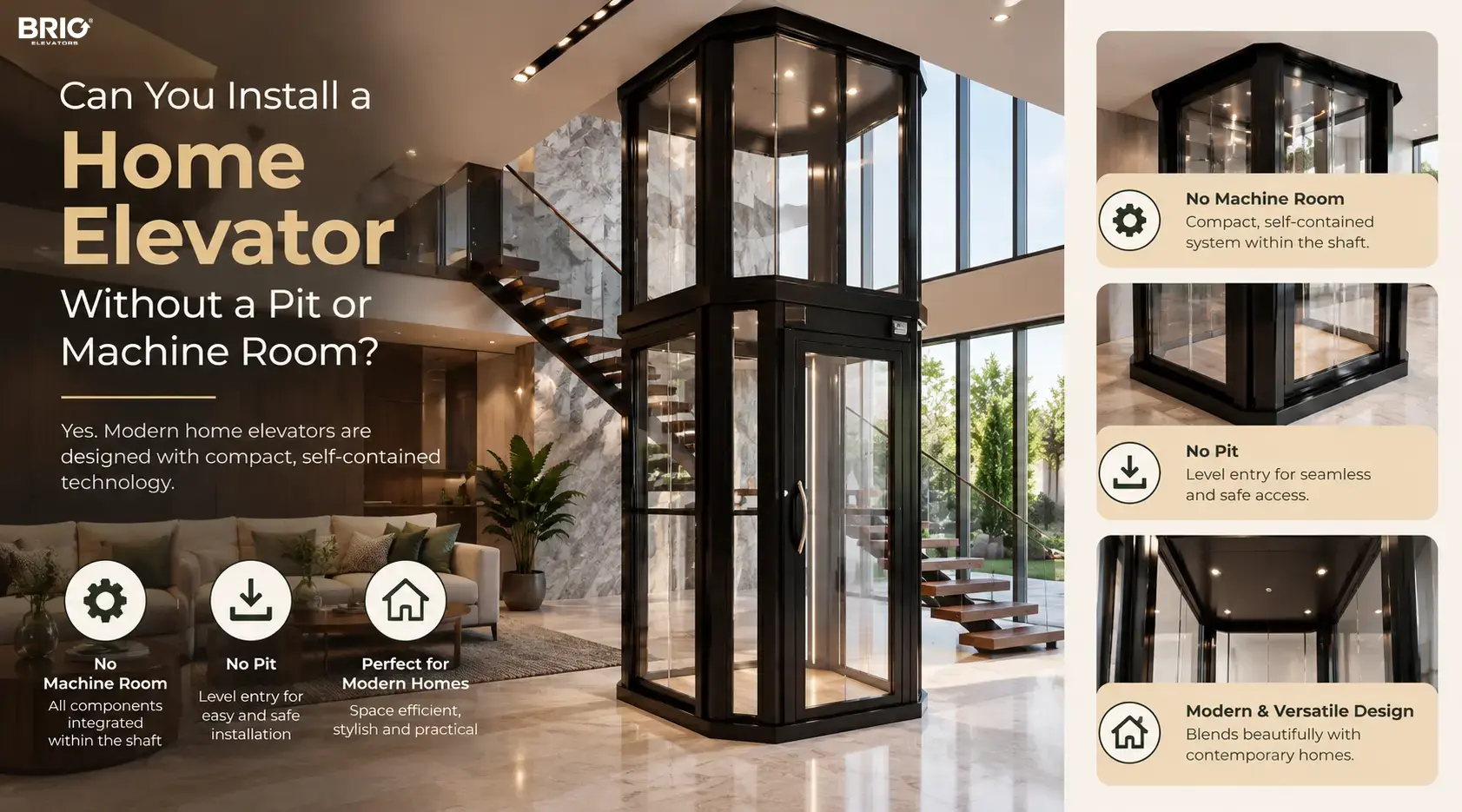
An MRL elevator is a popular choice for modern homes because it does not need a traditional separate machine room. But many homeowners also ask:
Can a home elevator be installed without a pit?
The answer is yes, depending on the elevator model.
Different home lifts need different amounts of space below the ground floor. Some need a small pit, some need a deeper pit, and some modern residential elevators can be installed without a conventional pit.
At Brio Elevators, for example:
So, before choosing a lift, it is important to understand the difference between a pit, machine room, and MRL elevator.
MRL stands for Machine Room Less.
Traditional elevators may require a separate room for the motor and other elevator equipment.
An MRL elevator is designed without a traditional separate machine room. The main equipment is placed within or around the elevator shaft, depending on the elevator design.
This helps save building space.
MRL elevators can be suitable for:
The important point is:
MRL means no traditional machine room. It does not mean no pit.
An elevator pit is the space below the lowest floor of the elevator.
It is located at the bottom of the lift shaft.
Depending on the elevator technology, this space may be required for:
Different elevators need different pit depths.
This is why homeowners should always ask about the pit requirement of the exact home elevator they are planning to install.
Yes, an MRL elevator can still require a pit.
This is one of the most common misunderstandings among homeowners.
An MRL system removes the need for a separate machine room, but the elevator may still need space below the lowest floor.
At Brio, MRL elevator solutions may require around 3 to 5 feet of pit, depending on the model, building, and project requirements.
So, when discussing an MRL elevator, ask two separate questions:
Does it need a machine room?
How much pit does it need?
They are two different things.
Yes.
Some modern home lifts are designed to work with a much smaller pit compared with conventional elevator systems.
At Brio:
The BE-200 requires around a 1-foot pit.
The BE-300 also requires around a 1-foot pit.
These options can be useful for homeowners who want a residential elevator without creating a very deep pit.
A smaller pit may also help reduce some civil work during construction.
Yes.
Some residential elevator models are designed without the need for a conventional pit.
At Brio Elevators, both the:
BE-360 Circular
and
BE-360 Octagonal
do not require a conventional elevator pit.
This can be useful when:
However, a no-pit elevator may still need proper base preparation and other installation work.
This is another important point.
A lift that does not require a conventional pit may still need some site preparation.
Depending on the property, this may include:
So homeowners should not assume that a no-pit elevator can simply be placed anywhere without preparation.
A site inspection is still important.
Yes.
That is one of the main benefits of an MRL elevator.
Instead of building a separate machine room, the elevator equipment is designed to fit within the lift system.
This can help homeowners:
For modern homes, this can be an important advantage.
When planning a lift, pit depth is not the only measurement to check.
You should also understand headroom.
Headroom is the space above the highest floor served by the elevator.
In simple words:
Pit = space below the lift
Headroom = space above the lift
Different elevator models have different headroom requirements.
Before selecting a lift, ask about:
This will help you plan the space correctly.
If your house is already completed, major construction work may be difficult.
In such cases, homeowners often look for home lifts with lower civil requirements.
For example, Brio's BE-360 Circular and BE-360 Octagonal do not require a conventional pit.
This can be useful where deep excavation is difficult.
The BE-200 and BE-300, which require around a 1-foot pit, may also be suitable where a small pit can be provided.
The final choice should depend on the property, available space, number of floors, and family requirements.
If you are building a new villa or independent house, it is better to plan the elevator early.
This gives the architect and elevator company time to plan:
When the lift is planned from the beginning, homeowners usually have more options.
A deeper pit required for an MRL elevator can also be planned more easily during construction.
Neither option is automatically better.
They solve different requirements.
The best option is the one that fits the building and family requirements.
A no-pit or shallow-pit elevator can be convenient, but pit depth should not be the only reason for choosing a lift.
Homeowners should also check:
When comparing the Top elevators, the complete solution is more important than one specification.
Whether an elevator needs no pit, a 1-foot pit, or a deeper pit, safety is always important.
Depending on the selected Brio model and configuration, safety systems can include features such as:
Homeowners should ask the elevator company to explain how these safety systems work before installation.
Every property is different.
Even two houses with the same number of floors may have different space and structural conditions.
A site inspection helps check:
After checking these details, the technical team can suggest a suitable elevator model.
The answer depends on your site.
These models may be considered when the property can provide around a 1-foot pit and meets the other installation requirements.
An MRL elevator may be considered when you want to avoid a separate machine room and the building can provide approximately 3 to 5 feet of pit, depending on the project.
The BE-360 Circular does not require a conventional pit, making it an option for homes where a deep pit is difficult to provide.
The BE-360 Octagonal also does not require a conventional pit and can be considered where reducing major pit construction is important.
The final recommendation should always be made after checking the site.
Before buying a home elevator, ask your elevator company:
These simple questions can help you understand the complete installation before making a decision.
At Brio Elevators, different homes need different elevator solutions.
There is no one model that is right for every property.
For example:
Before recommending an elevator, Brio considers the property layout, available space, number of floors, family usage, safety requirements, and design preferences.
The goal is to recommend a home elevator that works properly for the home, rather than selecting a model only because it has a smaller pit.
Yes, a home elevator can be installed without a traditional machine room and, with certain models, without a conventional pit.
But remember:
MRL means Machine Room Less. It does not mean Pitless.
At Brio, the BE-200 and BE-300 require around a 1-foot pit, MRL solutions may require around 3 to 5 feet, while the BE-360 Circular and BE-360 Octagonal do not require a conventional pit.
The best choice depends on your home, available space, number of floors, and family requirements.
A proper site inspection before installation is the easiest way to choose the right elevator.
📞 Call: +91 9398113939 🌐 Visit: brioelevators.com
No. An MRL elevator is designed without a traditional separate machine room.
Yes. Brio MRL solutions may require around 3 to 5 feet of pit depending on the model and project.
Both the BE-200 and BE-300 require around a 1-foot pit.
The Brio BE-360 Circular and BE-360 Octagonal do not require a conventional pit.
Yes. The suitable model depends on available space, structural conditions, pit possibilities, and other site requirements.

