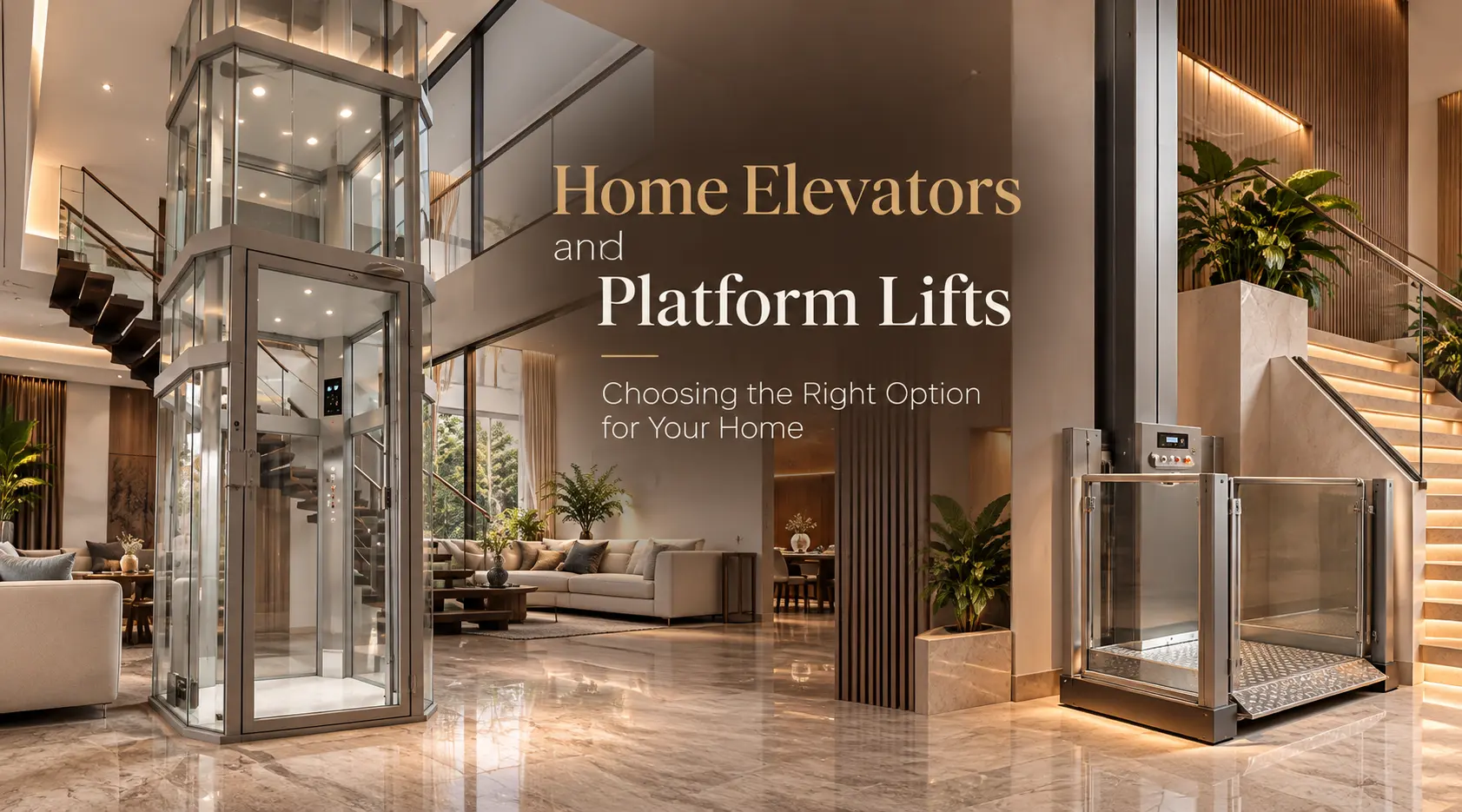
Platform Lifts and home elevators may look similar because both help people move between levels, but they are designed for different needs.
A platform lift is generally used when the main requirement is accessibility over a limited height or between a small number of levels. A home elevator is designed to provide regular, comfortable movement between floors for the entire family.
At Brio Elevators, we do not provide platform lifts. Brio focuses on dedicated home elevator solutions for villas, duplex homes, independent houses, and multi-floor residences.
This blog explains the difference between the two in simple language so homeowners can understand which type of solution is suitable for their property.
A platform lift is mainly designed to help a person move between different levels without using stairs.
It may be especially useful for:
Instead of a conventional elevator cabin, some platform lifts use a platform where the passenger can stand or enter with a wheelchair.
Depending on the system, platform lifts may be open or enclosed.
Their main purpose is usually accessibility rather than full everyday elevator travel for an entire household.
A home elevator is designed specifically for residential use.
It normally has an enclosed cabin and can connect multiple floors of a house.
A home elevator can be useful for:
Modern home elevators can also be designed to match the interiors of villas and premium residences.
For many families, the lift becomes a regular part of everyday living rather than only an accessibility device.
The easiest way to understand the difference is to look at the main purpose.
A platform lift is often chosen when the main requirement is helping a person overcome a smaller height difference or reach another level more easily.
A home elevator is usually chosen when the family wants comfortable movement between several floors as part of everyday life.
For example:
If a wheelchair user needs access between two nearby levels, a platform lift may be worth considering.
If a family wants regular movement between the ground floor, first floor, second floor, and terrace level, a home elevator may be the more suitable type of solution.
Neither option should be selected only by appearance.
The building and user requirements should come first.
Travel height is one of the first things to consider.
Platform lifts are commonly considered for shorter travel requirements, depending on the product and building.
Home elevators are designed for vertical movement between residential floors and can be configured according to the number of levels the selected model supports.
Before choosing either system, homeowners should identify:
These basic details can quickly help identify the more suitable option.
Ask yourself one simple question:
How often will the lift be used?
If the lift is mainly required to help one person overcome a specific accessibility challenge, a platform lift may meet that need.
If parents, children, grandparents, guests, and other family members will use it several times every day, a residential elevator may provide a more complete experience.
Frequent family use also makes factors such as these more important:
This is why the purpose of the lift should always be clear before selecting the technology.
A home elevator normally provides an enclosed cabin designed for passenger comfort.
Depending on the elevator model, homeowners may be able to choose:
A platform lift is usually more focused on practical accessibility.
Its design may therefore be simpler because its main job is to help the user move between levels.
If you want the lift to become part of the home's architecture and interior, a dedicated home elevator may provide more design flexibility.
Home elevator safety should be one of the most important factors in the buying decision.
Families should understand how the elevator behaves during normal use and emergencies.
Depending on the elevator model, safety features may include:
Different types of lifts may use different safety systems.
Instead of asking only how many safety features are available, homeowners should ask the company to explain how those features actually work.
Platform lifts also require suitable safety systems.
Because they may frequently be used by people with mobility limitations, proper design, installation, and maintenance are very important.
Depending on the system, platform lift safety can involve areas such as:
The exact safety arrangement depends on the product.
If your requirement is specifically for a platform lift, it is important to speak with a company that specialises in that type of accessibility equipment.
Whether you choose a platform lift or a home elevator, good accessibility involves the entire path of movement.
Homeowners should consider:
Simply installing a lift does not automatically make a home fully accessible.
The installation should be planned around the person who will actually use it.
Both options can help senior citizens, depending on their needs.
A platform lift may be suitable when the main goal is solving a specific accessibility problem over a limited vertical distance.
A home elevator may be more suitable when elderly family members need regular access to several floors throughout the day.
For senior citizens, families should consider:
The right solution should reduce effort rather than create another difficult system to operate.
For a villa or duplex where the family wants regular movement between multiple floors, a dedicated home elevator is generally the type of solution homeowners consider.
It can become part of daily activities such as:
The elevator can also be planned to match the architecture of the residence.
This is different from a platform lift whose main purpose may be solving a specific accessibility requirement.
Not every home has the same available space.
Before selecting any lift, a technical team should understand:
Homeowners should avoid selecting a product from photographs alone.
A site inspection can help determine what is actually possible inside the property.
It can be tempting to compare only quotations.
However, a platform lift and a home elevator are not necessarily providing the same type of experience or designed for the same use.
Homeowners should also compare:
The lowest price is useful only when the product also meets the actual requirement.
People often search online for the best elevators or top elevators, but there is no single model that is perfect for every property.
A better way to choose is to ask:
The best elevators are not simply the most expensive or the most advanced.
They are the ones that match the home and family properly.
No. Brio Elevators does not provide platform lifts.
Brio focuses on home elevators and residential elevator solutions designed for regular family use in properties such as:
If your requirement is specifically for a platform lift, such as a short-travel accessibility solution, it is better to work with a specialist platform-lift provider.
If your requirement is a complete elevator for everyday movement between floors, Brio can help assess your property and recommend a suitable home elevator from its range.
Being clear about this difference helps customers choose the correct product instead of purchasing a solution that does not match their needs.
At Brio Elevators, the focus is on creating a complete residential elevator experience.
This includes attention to:
Brio home elevators are planned around the property and the people who will use them.
The aim is not simply to move a person over a small height difference, but to provide convenient vertical movement as part of everyday home life.
You can make the decision easier by starting with your main requirement.
These are general guidelines. The final decision should be based on the property and user requirements.
Before selecting either option, ask:
Clear answers can help prevent choosing the wrong type of product.
Platform Lifts and home elevators are designed for different needs.
Platform lifts mainly focus on accessibility and can be useful for certain short-travel applications. Home elevators are designed for regular family movement between floors, with greater focus on cabin comfort, everyday convenience, design, and residential use.
Brio Elevators does not provide platform lifts. Brio focuses on dedicated home elevator solutions for families looking for safe, comfortable, and convenient movement throughout their homes.
The right choice starts with understanding what your home and family actually need.
📞 Call: +91 9398113939 🌐 Visit: brioelevators.com
A platform lift is mainly designed to help people, including wheelchair users, move between different levels over suitable travel distances.
A platform lift mainly focuses on accessibility, while a home elevator is designed for regular passenger movement between residential floors.
No, Brio Elevators focuses on dedicated home elevator and residential elevator solutions rather than platform lifts.
A home elevator is generally more suitable when the w
The whole family needs regular and comfortable access between several floors.
Check suitability, home elevator safety, space, comfort, accessibility, installation quality, maintenance, and after-sales support.

