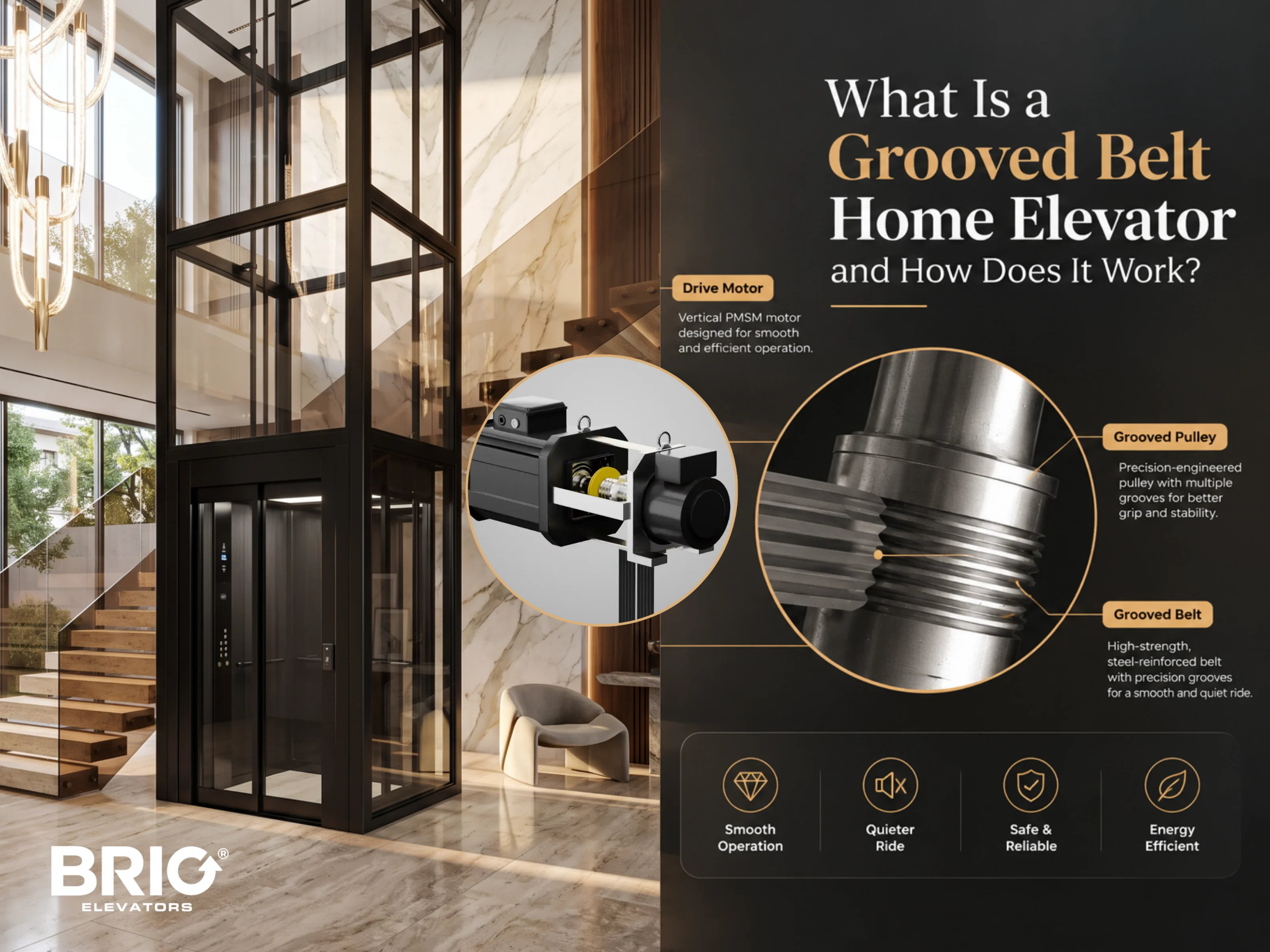
A Grooved Belt Home Elevator is a modern residential elevator that uses a specially designed belt, pulley and motor system to move the cabin between floors.
Compared with older elevator drive systems, grooved belt technology can provide smooth movement, compact engineering and better use of available space.
At Brio Elevators, the BE-300 uses modern grooved belt technology designed specifically for residential applications. It combines a grooved belt drive with a vertical PMSM motor to provide smooth and controlled movement for everyday home use.
In this blog, we explain how grooved belt technology works, its benefits and how it is used in the Brio BE-300 home elevator.
A Grooved Belt Home Elevator uses an engineered belt to move the elevator cabin.
The belt works together with a specially designed pulley and electric motor.
The working process is easy to understand:
Motor rotates → Pulley moves → Grooved belt travels → Elevator cabin moves
The entire movement is managed by the elevator controller.
This allows the cabin to start, travel and stop in a controlled manner.
A grooved belt is not an ordinary belt.
It is specially designed to work with the elevator's drive pulley.
The grooves help the belt maintain proper contact with the pulley while the elevator is moving.
The system includes several parts working together:
The belt is only one part of the complete elevator system.
The working process takes place in a few simple steps.
After entering the elevator, the passenger selects the required floor.
The elevator controller receives the command.
The motor begins operating and creates the movement required to drive the elevator.
The motor turns the grooved drive pulley.
As the pulley rotates, the grooved belt moves in the required direction.
The belt system helps move the elevator cabin upward or downward.
As the cabin approaches the selected floor, the controller reduces its speed.
The elevator reaches the required floor and stops in a controlled position.
All these steps happen automatically during normal operation.
At Brio Elevators, the BE-300 is a grooved belt home elevator designed for residential use.
The BE-300 combines a vertical PMSM motor with a grooved belt drive system.
This modern arrangement helps provide:
The BE-300 is designed for villas, duplex houses and multi-floor homes where homeowners want a modern elevator solution for regular family use.
PMSM stands for Permanent Magnet Synchronous Motor.
It is a modern electric motor used for controlled and efficient movement.
In the Brio BE-300, the vertical PMSM works with the grooved belt system to move the elevator.
This type of motor can support:
The motor, belt, pulley and controller work together as one complete drive system.
Home elevators need to provide comfortable movement while also making good use of available residential space.
Grooved belt technology helps create a compact elevator drive arrangement.
For the Brio BE-300, this means the system can provide modern elevator performance while being designed around the needs of residential properties.
It is not simply about replacing a rope with a belt.
The complete home elevator technology is designed around the motor, belt, drive system, controls and safety systems.
Brio's latest BE-300 grooved belt system is designed without a conventional counterweight.
Traditional traction elevators often use a counterweight inside the elevator shaft.
Removing the conventional counterweight can help make better use of the available shaft space.
This can be useful in residential properties where every part of the available space matters.
Yes.
The Brio BE-300 requires around a 1-foot pit, depending on final site and installation requirements.
A shallow pit can be useful for residential projects because it requires less excavation than many traditional elevator systems.
However, the property should always be checked by the technical team before construction begins.
The exact requirements should be confirmed according to the site.
Comfort is important in a home elevator because family members may use it many times every day.
The grooved belt, PMSM motor and controller work together to manage the cabin movement.
This helps provide smooth:
Smooth movement is especially useful for senior citizens, children and people who use the elevator frequently.
A residential elevator is installed close to living spaces, so operating noise is important.
A properly installed grooved belt and motor system can provide controlled and smooth movement with reduced mechanical noise.
However, quiet operation also depends on:
The complete installation affects the final ride experience.
The belt alone does not decide whether an elevator is safe.
Safety depends on the complete elevator system.
Depending on the model and configuration, a modern home elevator can include systems such as:
When comparing the best elevators, homeowners should understand how the complete safety system works.
Power failure is an important concern when choosing a home elevator.
Modern elevator systems can include backup and rescue systems.
If the main electricity supply stops, an Automatic Rescue Device can help the elevator respond according to the system design.
Backup power may support functions such as:
Homeowners should always ask what happens to the exact elevator model during a power failure.
An elevator grooved belt is an engineered component designed specifically for elevator operation.
It should not be compared with an ordinary belt used in household equipment or vehicles.
The belt works as part of a complete engineered system that includes the motor, pulley, controller and safety systems.
Regular inspection is also important for long-term performance.
Yes.
Every elevator needs regular professional maintenance.
For a grooved belt system, technicians may inspect:
Regular maintenance helps the elevator continue to provide smooth and reliable operation.
Yes. The Brio BE-300 is designed as a residential home elevator solution.
It can be considered for:
The suitability of the elevator depends on the available space, number of floors, travel requirement and other site conditions.
A technical site inspection should always be completed before finalising the elevator.
It may be possible depending on the property.
The technical team needs to check:
Since the BE-300 needs around a 1-foot pit, the site should have suitable conditions to provide that space.
A hydraulic elevator and grooved belt elevator move differently.
Hydraulic elevator:
Motor → Pump → Hydraulic fluid → Cylinder → Cabin movement
Grooved belt elevator:
Motor → Pulley → Grooved belt → Cabin movement
Both technologies can be used for residential applications.
The right choice depends on:
Space is valuable in villas and duplex homes.
A compact elevator system can help make better use of the available lift area.
Modern grooved belt technology can support efficient use of the shaft by reducing the need for some larger traditional components.
This can also help provide better flexibility when planning the elevator within the home's architecture.
Before selecting a Grooved Belt Home Elevator, ask:
These questions help homeowners understand the complete elevator instead of choosing only by technology name.
The Brio BE-300 Grooved Belt Home Elevator combines modern drive technology with a residential-focused design.
Its key technology includes:
For homeowners exploring modern home elevator technology, the BE-300 provides an option designed around everyday family use.
There is no single elevator that is best for every property.
The best elevators are the ones that match the home, family and technical requirements.
A Grooved Belt Home Elevator such as the Brio BE-300 may be suitable when homeowners are looking for:
A proper site assessment should always come before the final decision.
A Grooved Belt Home Elevator uses an engineered belt, drive pulley and motor to move the elevator cabin smoothly between floors.
At Brio Elevators, the BE-300 uses grooved belt technology combined with a vertical PMSM motor to provide a modern residential elevator solution.
The BE-300 is designed without a conventional counterweight, requires around a 1-foot pit, and focuses on smooth movement, compact engineering and comfortable everyday use.
For homeowners comparing modern elevator technologies, understanding how the motor, belt, controls and safety systems work together is more important than looking at a single feature.
📞 Call: +91 9398113939 🌐 Visit: brioelevators.com
The Brio BE-300 uses modern grooved belt technology with a vertical PMSM motor.
Its PMSM motor rotates the drive system, moving the grooved belt and controlling the movement of the elevator cabin.
Yes, the BE-300 requires around a 1-foot pit, subject to final site requirements.
Brio's latest BE-300 grooved belt system is designed without a conventional counterweight.
Yes, the BE-300 is designed as a residential elevator solution for suitable villas, duplex houses and multi-floor homes.

