When people think about installing a home elevator, the conversation usually starts with design, comfort, and how well it fits into the space. But very quickly, one practical question comes up:
What happens if there’s a power cut while someone is inside the lift?
It’s a completely valid concern.For many homeowners, especially those living in duplex homes or villas, the lift is something the entire family uses every day. Children may use it on their own, elderly parents may depend on it, and guests often use it without a second thought.
That’s why safety features matter just as much as the design.
This is where ARD in home elevators becomes one of the most important features to look for.
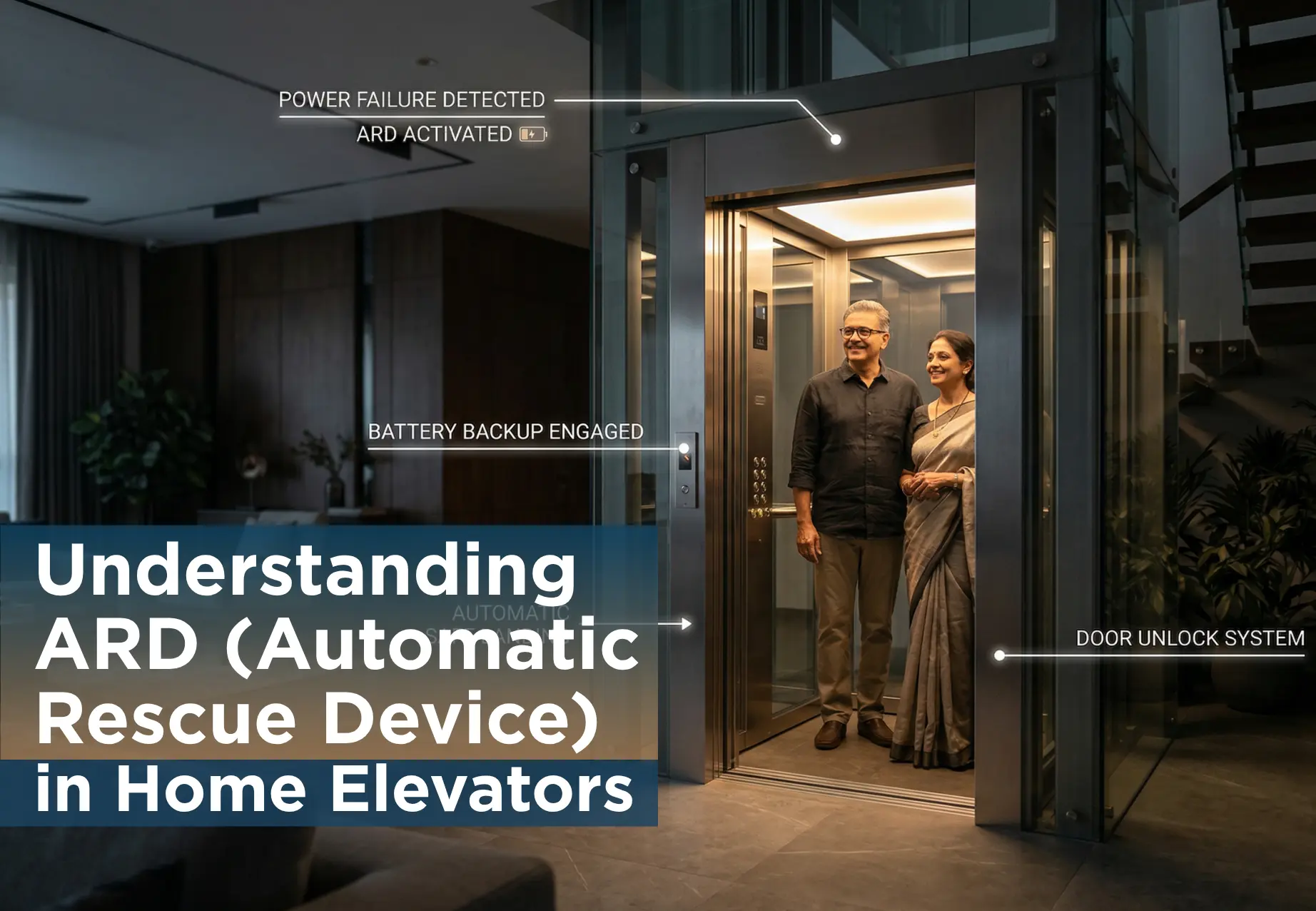
ARD, or Automatic Rescue Device, is the system that steps in during a sudden power failure. Instead of the lift stopping between floors and leaving the passenger waiting inside, it automatically uses backup power to bring the cabin to the nearest floor and opens the doors safely.
In simple words, it ensures no one is left stranded.And honestly, that peace of mind is what makes a home elevator feel truly reliable.
Most people don’t think deeply about lift safety until they imagine a real situation.
Picture this.
It’s raining outside, the lights suddenly go off, and your parents are in the lift moving from the first floor to the ground floor.Without a proper backup system, the cabin could stop midway.
Even if it’s only for a few minutes, that moment can feel uncomfortable and stressful. With ARD in home elevators, the system reacts almost instantly.The lift gently moves to the nearest floor and the doors open automatically.There’s no panic, no need to call for help, and no fear of being stuck.
That’s why many families specifically ask about this feature before making a decision.
An automatic rescue device elevator is built to handle one very specific situation: power failure.
The moment the main power supply is interrupted, the system detects it. Its then switches to battery backup and powers the lift just enough to safely reach the closest floor.
Once the cabin reaches the floor, the doors open automatically.A good automatic rescue device elevator does all of this smoothly, without the passenger needing to do anything.
For the person inside, it simply feels like the lift safely completes the journey.That sense of seamless safety is exactly why ARD is so valuable.
Let’s be practical. Power cuts and voltage fluctuations are still something many households in India experience, whether in metro cities during monsoons or in developing residential areas.
Because of this, the elevator backup system India market places strong emphasis on rescue and safety features.
For Indian homeowners, a dependable power failure elevator solution is not something optional.
It’s something they genuinely need. This becomes even more important in homes where senior citizens rely on the lift daily. A sudden power cut should never become a stressful moment.
The technology behind it is straightforward but highly effective.
The system immediately senses when the main power goes off.
The elevator backup system India usually includes a built-in battery system that takes over instantly.
The cabin gently travels to the nearest floor.
Once it reaches the landing, the doors open automatically.
The lift remains safely inactive until electricity is restored.
This complete power failure elevator solution is designed with one purpose — passenger safety.
For homeowners, trust matters more than anything else.A lift should not just look premium.It should feel dependable every single day.
Among all lift safety features ARD is one of the most reassuring because it addresses a very real fear.
No one wants to imagine being stuck inside a lift.That’s why lift safety features ARD often become one of the first things customers ask about.
It builds confidence, especially for families with children and elderly parents.
Sometimes, the most important features are the ones people notice only in emergencies.ARD is one of them.
You may not think about it every day, but the moment there is a power cut, it becomes the feature that matters most.
That is why ARD in home elevators is considered essential in modern residential lifts.
It transforms the experience from “what if something goes wrong?” to “we know it’s taken care of.”
A home elevator should make life smoother, more comfortable, and above all, safer.That is exactly what ARD in home elevators helps achieve.
It protects your loved ones during unexpected power cuts and ensures that the lift remains reliable in real-life situations.Sometimes, true luxury is not just design.
It is the confidence that your family is always safe.
CTA:
Looking for a home elevator with advanced ARD safety technology? Connect with our Brio experts today and discover safe, stylish, and dependable lift solutions designed for modern homes.
ARD stands for Automatic Rescue Device, which safely moves the lift to the nearest floor during a power cut.
Yes, it activates automatically the moment the power supply fails.
It is especially useful because power cuts and voltage fluctuations are still common in many areas.
Yes, it is one of the most important safety features for elderly users.
Yes, regular servicing is recommended to ensure the battery backup works properly.