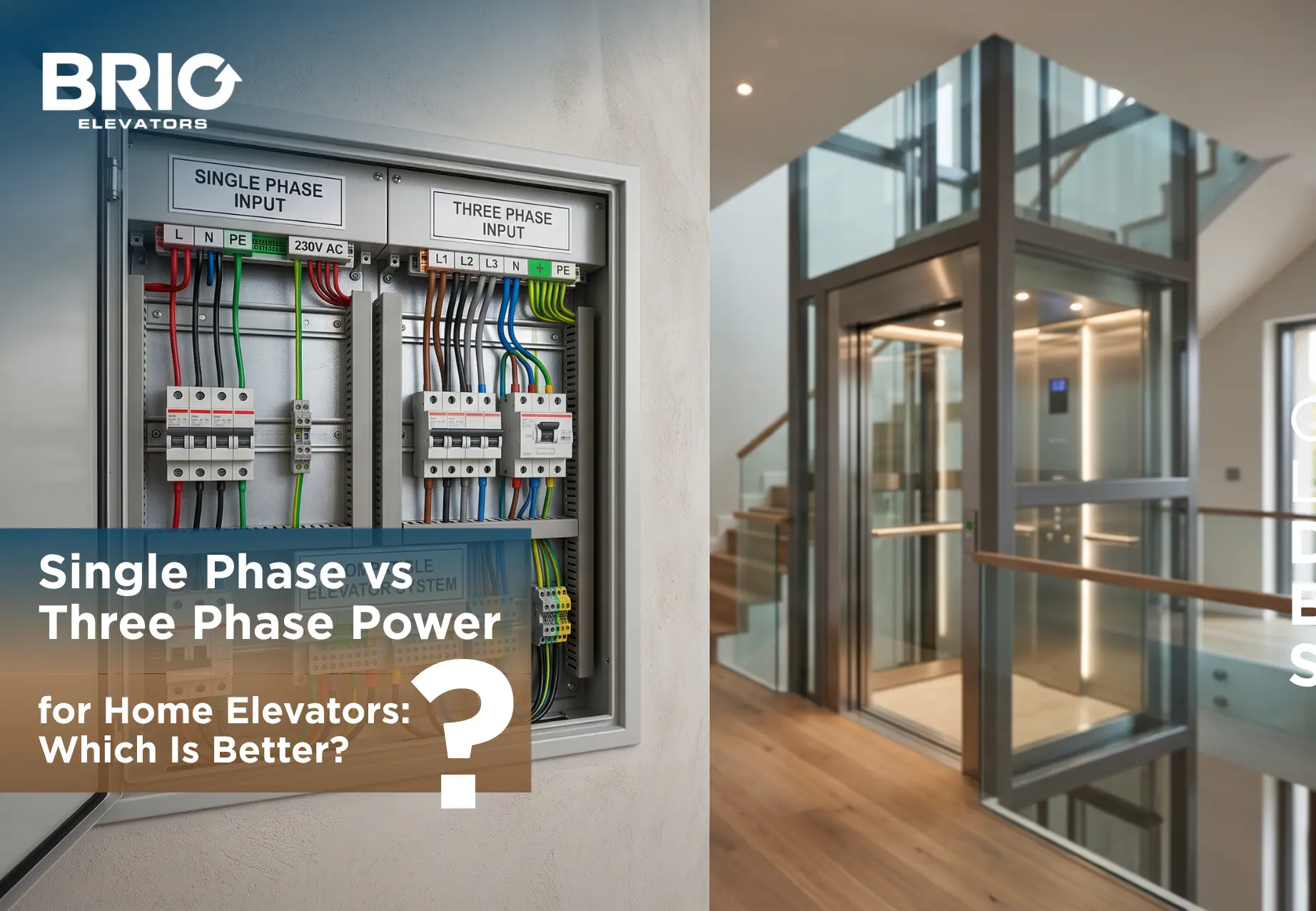
When people start researching home elevators, they expect to think about design, space, and budget. What they don't expect is a conversation about electrical phases.
But here it is one of the most practical questions you'll face before installing a home lift: Does your elevator need a single phase or three phase power connection?
If you're not an electrician, this probably sounds intimidating. It doesn't need to be. By the end of this blog, you'll know exactly what the difference means, why it matters for your home lift, and which option makes more sense for an Indian household.
Let's break it down simply.
First, What Even Is a "Phase" in Electrical Terms?
Think of electrical power as water flowing through pipes. A single phase connection has one pipe and one continuous flow of alternating current. A three phase connection has three pipes three simultaneous flows of current, offset from each other, delivering power in a more balanced and consistent way.
In India, most residential homes are connected to single phase supply (230V) the same connection that powers your lights, fans, refrigerator, and air conditioners. Industrial units, large commercial buildings, and factories typically use three phase supply (415V), because they run heavy machinery that demands higher, more consistent power.
That's the core difference. Now let's see how it applies to home elevators.
For decades, this was largely true and it's why many homeowners assume a home lift will require a special electrical connection.
Traditional elevators use hydraulic or geared traction motors that draw significant power on startup and during operation. These motors run more efficiently and smoothly on three phase supply, which delivers power in a steadier, more balanced way. For commercial lifts in offices, malls, and hospitals where the elevator runs continuously and carries heavy loads three phase is the practical necessity.
But here's where the conversation shifts for home elevators.
The home elevator market has evolved dramatically. The motors used in modern residential lifts are fundamentally different from their commercial counterparts, smaller, smarter, and far more efficient.
Today's premium home lifts, including Brio's range, use electric drive systems with Variable Frequency Drives (VFDs) and compact motors engineered specifically for low-frequency, low-load residential use. These systems are designed to operate efficiently on single phase power, the connection already available in virtually every Indian home.
What does this mean for you practically?
|
Factor |
Single Phase |
Three Phase |
|
Availability in Indian homes |
Standard in all residences |
Requires separate industrial/commercial connection |
|
Installation complexity |
Simple — existing supply is sufficient |
Requires new connection, upgraded wiring |
|
Cost of connection |
Minimal |
Higher deposit, setup cost, monthly charges |
|
Suitable for home lifts? |
Yes — with modern electric drive systems |
Yes — but overkill for residential use |
|
Motor smoothness |
Excellent with VFD technology |
Excellent |
|
Energy efficiency |
High with modern systems |
High, but higher base consumption |
|
Ideal for |
Residential home lifts |
Commercial lifts, heavy-load applications |
The verdict for home use? Single phase wins — not because three phase is inferior, but because it's simply unnecessary for a residential elevator, and the additional cost and complexity bring no meaningful benefit to a homeowner.
This is one of the most searched questions around home elevator power requirements in India and the answer is simpler than most people expect.
A modern single phase home lift like Brio's BE 360 or BE 300 typically operates on:
In practical terms, your home lift's monthly electricity cost is negligible compared to the convenience it provides. Many homeowners are surprised to find their electricity bill barely moves after installing a home elevator.
The Lift Electricity Connection in India: What You Actually Need to Arrange
If you're installing a Brio home elevator, here's what you need to have in place electrically:
1. A dedicated circuit: While your lift runs on standard single phase supply, it should ideally be on its own dedicated circuit separate from other high-load appliances. This is a simple task for any licensed electrician and typically takes an hour.
2. An MCB (Miniature Circuit Breaker): A correctly rated MCB for the lift circuit, to protect against overload. Brio's installation team will specify the exact rating needed.
3. Earthing: Proper earthing at the lift connection point standard practice for any major appliance in India.
4. A nearby power point: The supply connection point should ideally be within a reasonable distance of the lift installation location. Again, straightforward for any electrician.
That's genuinely it. No three phase connection. No special meters. No visits to the DISCOM office for an industrial supply application.
What About Power Cuts? Does the Home Lift Get Stuck?
This is the follow-up question almost everyone asks and it's a fair one, given how common power outages are in many parts of India.
Modern Brio home elevators come with a battery lowering system (ARD — Automatic Rescue Device). In the event of a power failure, the ARD automatically brings the lift to the nearest floor and opens the doors safely and without any action required from the person inside.
For homes in areas with frequent outages, an additional UPS or backup power system can be integrated. This allows the lift to continue operating normally for a limited number of trips even during a power cut. Brio's team can recommend the right backup solution based on your usage pattern and location.
A Quick Word on Energy Efficiency
One of the real advantages of modern single phase home lifts in India is how energy-conscious they've become.
Brio's electric drive system uses regenerative technology and intelligent motor management meaning power is consumed only when the lift is actively moving, and at optimised levels throughout the journey. Standby power consumption is minimal.
Compare this to older hydraulic lifts, which often kept their pump motors running continuously, a significant and unnecessary draw on your electricity supply.
If you're building a green home or simply mindful of energy use, a modern single phase home elevator is entirely compatible with that philosophy.
The Bottom Line
Single phase vs three phase elevator is a question with a clear answer for residential use: single phase is better for home elevators, more practical, more accessible, and more cost-effective for Indian homeowners.
Three phase connections have their place in commercial buildings, in high-rise apartments with multiple heavy-duty lifts, and in industrial settings. For a home with two, three, or four floors and a family that wants smooth, convenient vertical movement, single phase power is completely sufficient with today's elevator technology.
The good news? If you have a home in India, you almost certainly already have everything you need to power a Brio home elevator. The electrical side of things is rarely the complication people fear it will be.
Want to Know Exactly What Your Home Needs?
Every home's ceiling heights, floor distances, existing wiring, and usage patterns all play a role in specifying the right setup. Brio's team will assess all of this during a free site visit, with no obligation.
📞 Call: +91 9398113939 📧 Email: sales@brioelevators.com 🌐 Visit: brioelevators.com
Brio Elevators is present across Hyderabad, Vijayawada, Bangalore, Chennai, Kerala, Coimbatore, Indore, Goa, Dehradun, Guwahati, Bhubaneswar and internationally in Malaysia, Australia (coming soon), Indonesia (coming soon), and UAE (coming soon).