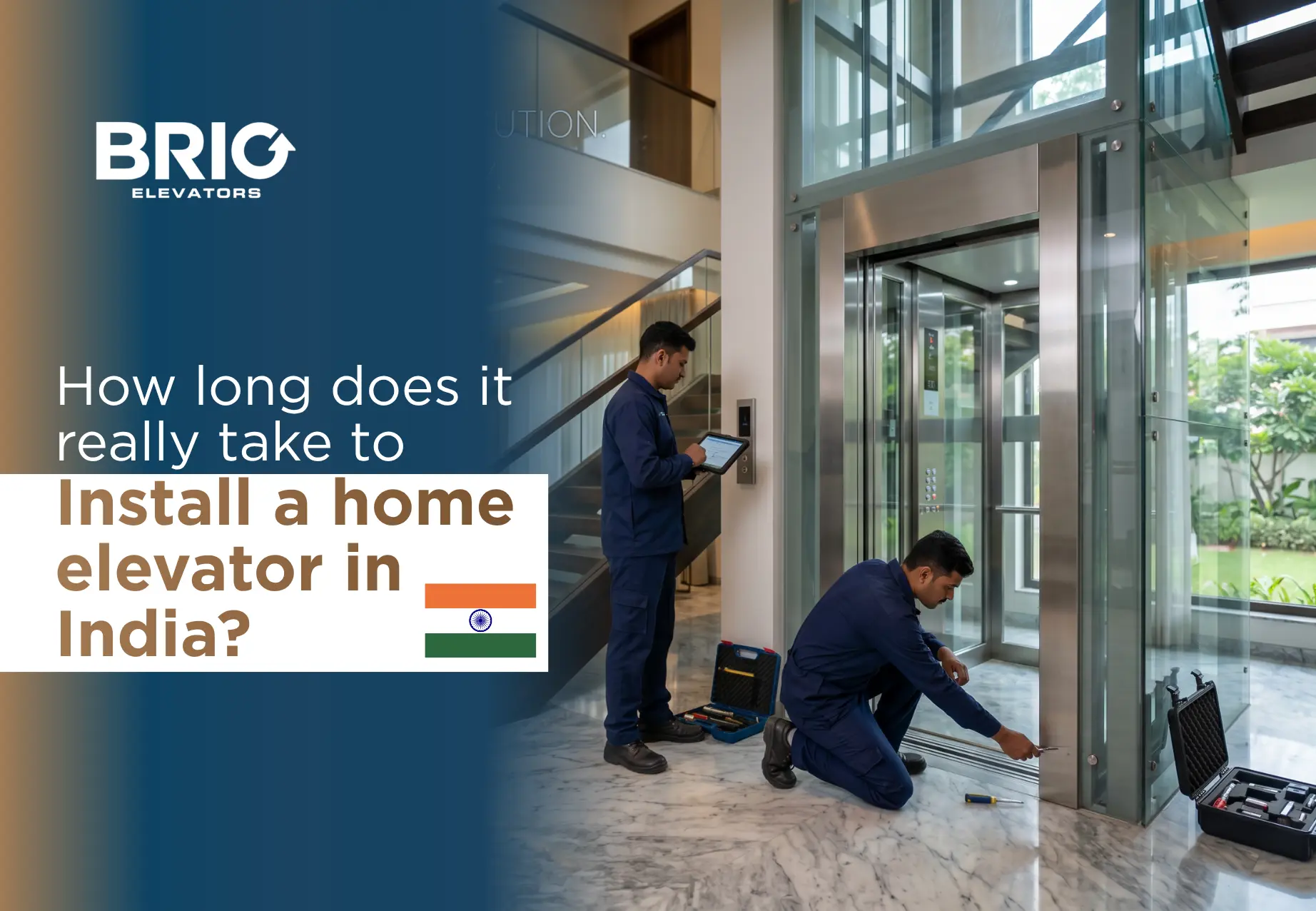
You've made the decision. A home elevator makes sense for your parents, for your lifestyle, for the long-term value of your home. Now comes the practical question that every homeowner eventually asks:
"How long is this actually going to take?"
Because let's be real you're not just asking about days on a calendar. You're asking how long your home will be a construction site. How long workers will be moving through your living space. How many mornings you'll wake up to drilling sounds instead of silence.
It's a completely valid concern. And the honest answer might surprise you.
With modern home elevator technology like Brio's BE 360, the home elevator installation time in India is a structured, well-planned process and understanding each stage helps you prepare your home and your schedule with confidence.
Let's walk through exactly what happens, and when.
A home elevator isn't a piece of furniture you order online and assemble over a weekend. It's a precision-engineered system that needs to be manufactured to your home's exact specifications, shipped, and then carefully installed and commissioned by trained professionals.
From the day you make your first inquiry to the day you take your first ride, the full journey including production, logistics, civil preparation, assembly, and safety testing typically spans around 3 months. Each stage has a purpose, and understanding why helps set the right expectations from the start.
Here's an honest breakdown of the home lift installation process in India with Brio from your first inquiry to the day you take your first ride.
Stage 1: Site Visit & Assessment
Time: Within the first 1–2 weeks of inquiry
Before anything else, Brio's team visits your home to assess the space. They'll identify the best installation location, check structural suitability, measure floor-to-floor heights, and note the electrical setup.
This visit is free and takes roughly 1–2 hours at your home. You'll come away with a clear picture of what's possible, what's needed, and what the installation will involve with no obligation to proceed.
Stage 2: Design Selection & Order Confirmation
Time: 1–2 weeks
Once you've decided to go ahead, you'll choose your lift model, cabin finish, glass type, flooring, and other customisation options. Brio's team guides you through this it's not complicated, but it's worth taking the time to get it right, since these choices directly affect how the lift integrates with your home's interiors.
After confirmation, your lift goes into production. This is where a significant portion of the overall timeline sits. Your elevator is manufactured to your exact specifications, quality-checked, and prepared for dispatch. Production and logistics typically account for 6–8 weeks of the overall schedule, depending on the model and customisation level.
Stage 3: Civil Preparation at Your Home
Time: 1–2 weeks (scheduled around lift arrival)
While your lift is in production, Brio's team coordinates civil preparation at your home. This stage is planned carefully so that your home is ready precisely when the lift components arrive minimising the gap between civil completion and installation.
For Brio's pit-free, machine-room-less elevators, civil preparation typically involves:
The civil work itself is completed relatively quickly, but scheduling it to align with the lift's production and arrival takes coordination and is factored into the overall 3-month timeline.
Stage 4: Lift Installation & Assembly
Time: 3–5 days at your home
This is where the elevator itself goes in. Brio's trained installation team assembles the lift structure floor by floor the guide rails, the cabin frame, the glass panels, the drive mechanism, the door systems, and the control panel.
For the BE 360 octagonal lift, the self-supporting structure means the team isn't building a heavy shaft around the lift. This keeps the on-site assembly work focused and clean, without large crews or heavy machinery disrupting your home.
The team works systematically, and the process is far quieter than most homeowners anticipate more mechanical assembly than construction work.
Stage 5: Wiring, Testing & Commissioning
Time: 1–2 days
Once assembled, the electrical connections are made, safety systems are tested, and the lift is run through a full commissioning procedure. This includes:
Every Brio elevator is tested against 8 layers of safety compliance before handover. This stage is non-negotiable and it's what separates a safe, certified installation from a rushed one.
Stage 6: Handover & Training
Time: A few hours
On the final day, Brio's team walks you through operating the lift, explains the safety features, and hands over all documentation including the warranty. You'll know exactly what to do and who to call for any future maintenance needs.
Putting it all together, here's how the timeline typically unfolds from your first call to your first ride:
The first month covers your site visit, design consultations, order confirmation, and the beginning of production. This is the planning and decision-making phase and getting it right here sets up everything that follows smoothly.
The second month is largely the production and logistics phase. Your lift is being manufactured to your specifications, quality-checked, and prepared for dispatch. Simultaneously, civil preparation at your home is being planned and scheduled.
By the third month, the lift has arrived, civil work is complete, and the installation team moves in. Assembly, wiring, and testing wrap up within this final phase and your elevator is commissioned and handed over.
The total active work time at your home, the period when the team is actually on-site is a relatively small window within this overall journey. The bulk of the timeline is production, logistics, and coordination happening behind the scenes.
Every home is different, and a few factors can stretch or compress the schedule:
Number of floors — More floors means more landing cuts, more door openings, and more assembly work. Each additional floor typically adds 15–20 days.
Customisation level — Standard finishes and configurations ship faster. Highly customised cabins with special materials may have slightly longer production timelines.
Civil condition of the home — Older homes occasionally present unexpected structural considerations that need addressing before installation proceeds. Brio's site visit is specifically designed to identify these in advance.
Access to the installation area — In tight urban homes or apartments with narrow common areas, moving components into position can take longer. Brio's team plans for this during the site visit.
Permit requirements — In some apartments and gated communities, committee or RWA approval is required before civil work begins. Brio's team can guide you through this process, but the timeline depends on your specific society.
What to Expect When the Team Is at Your Home
For homeowners who want to know what life looks like during the on-site installation phase here's a realistic picture:
Civil days: A small team arrives with cutting equipment. Floor openings are marked and precisely cut. Expect some noise and dust concentrated in the installation zone. The rest of your home is unaffected and fully livable.
Assembly days: The installation team assembles the lift structure floor by floor guide rails, cabin frame, glass panels, doors, and controls. The work is methodical and relatively quiet, more like mechanical assembly than construction. Most families are surprised by how undisruptive this phase is.
Testing & commissioning: The team runs the lift through its full safety and performance checks. Every system is verified before handover. This is thorough, unhurried work because a home elevator needs to be right, not just fast.
By the time the team leaves, your lift is fully operational, safety-certified, and ready for daily use.
Home elevator installation time in India — done properly takes around 3 months from inquiry to handover. That's not a long time when you consider what's happening: a lift is being custom-manufactured to your home's exact specifications, shipped, and then professionally installed and safety-certified.
The disruption to your daily life during this period is minimal. Most of the timeline is production and logistics happening away from your home. When the team does arrive for installation, the on-site work is clean, organised, and completed within days.
If you've been putting off the decision because you weren't sure what to expect now you know. Three months from today, you could have a fully operational home elevator.
Every home has its own specifics. The fastest way to get an accurate timeline for your space is a free site visit from Brio's team — no cost, no obligation, just clear answers.
📞 Call: +91 9398113939 🌐 Visit: brioelevators.com