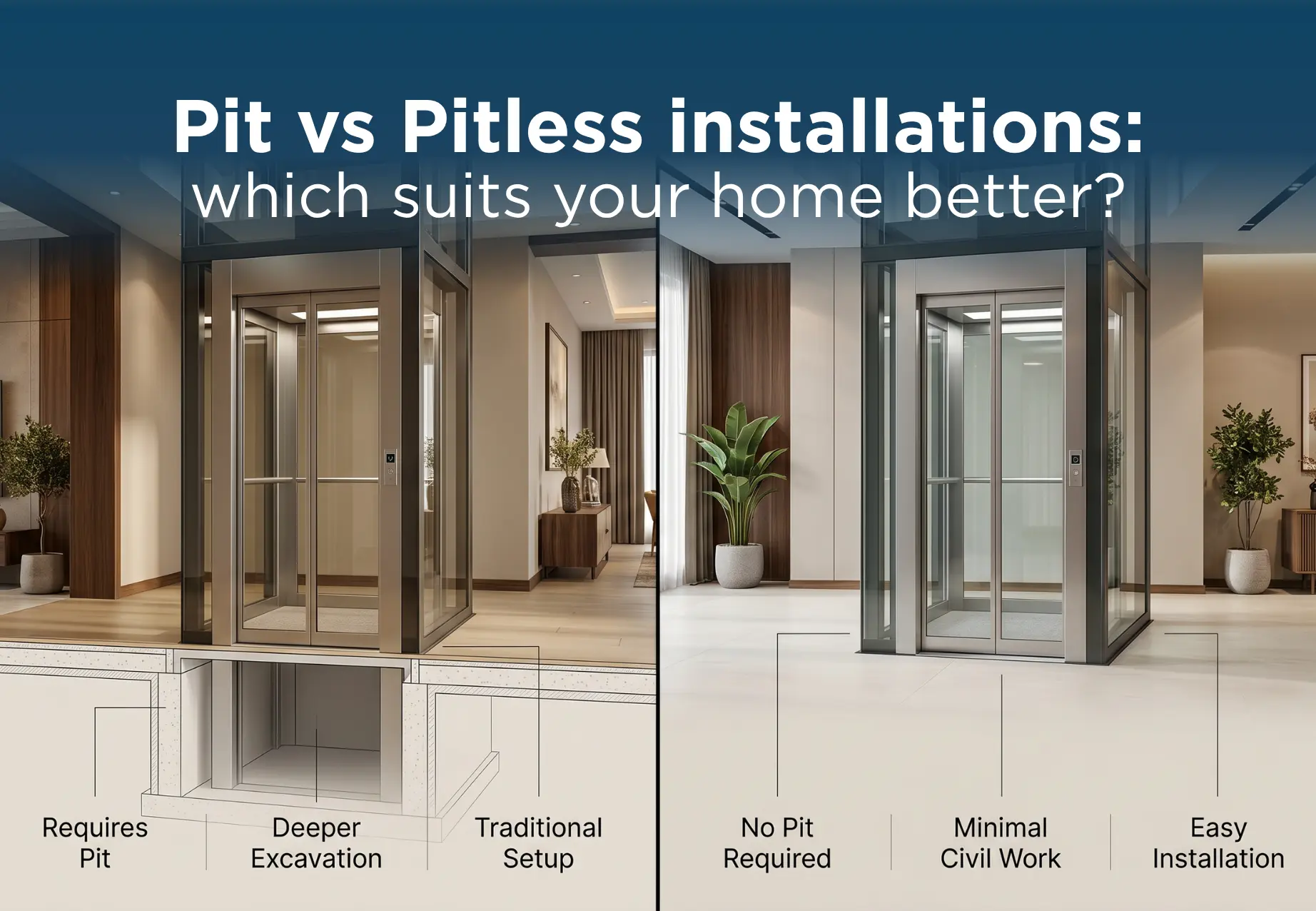
If you've started researching home elevators in India, you've probably come across the terms "pit" and "pitless" and wondered what exactly they mean, and why they matter.
Here's the short version: the type of installation your elevator requires can significantly affect the civil work involved, the cost, the disruption to your home, and ultimately, which lift is right for your space.
This blog breaks it down clearly so whether you're building a new home, renovating an existing one, or an architect specifying for a client, you'll know exactly what to look for.
What Is a Pit in a Home Elevator?
A pit is an excavated space below the ground floor level typically 600mm to 1000mm deep that sits beneath the elevator shaft. In traditional elevator systems, this pit serves several purposes:
For a home being designed from scratch, a pit can be planned into the foundation it's additional civil work, but manageable when accounted for early.
For an existing home, however, a pit is a serious complication. Excavating below an already-laid floor slab means breaking through finished flooring, potentially disturbing the foundation, and significant reconstruction work is disruptive, time-consuming, and costly.
A pitless elevator also called a zero-pit or pit-free elevator is exactly what it sounds like: a home lift that requires no excavation below the ground floor.
The lift system is self-contained from the base up. All mechanical components, buffers, and travel mechanisms are engineered to work within the existing floor level, without needing anything below it.
For homeowners and builders researching pitless home elevators in India, this is the defining advantage: your ground floor slab, foundation, and finished flooring remain completely untouched.
This is where the difference is most felt especially in home elevator civil work in India, where construction conditions vary widely.
A pit installation requires:
A pitless installation requires:
For new constructions, both are achievable with planning. For existing homes, pitless is almost always the practical and often the only viable option.
The civil work for a pit adds meaningful cost to the overall elevator project. Beyond the excavation itself, waterproofing a pit is non-negotiable in most Indian climates particularly in monsoon-prone cities like Hyderabad, Bangalore, Chennai, and Kerala. A poorly waterproofed pit leads to moisture ingress, which affects the lift's mechanical components over time.
With a pitless home elevator in India, these costs simply don't exist. There's no excavation, no waterproofing, and no ongoing maintenance concern related to pit conditions.
Suitability for Existing Homes
For homeowners in already-built houses particularly independent villas, duplexes, and older properties the choice becomes very clear.
Digging a pit in an existing home means:
An elevator without a pit for home retrofitting removes every one of these complications. The installation begins at ground level and builds upward with no downward excavation required.
Suitability for New Constructions
For homes currently in the design or construction phase, a pit can be incorporated into the foundation plan without the complications of retrofitting. If you know from the start that you want a traditional traction or hydraulic elevator that requires a pit, the architect and structural engineer can account for it early.
However, even in new constructions, many architects and homeowners today are choosing pitless systems not because they can't build a pit, but because they don't need to. Pitless technology has matured to the point where it delivers the same smooth, safe ride without the additional civil burden.
Safety and Maintenance
Modern pitless elevators meet the same and in many cases higher safety standards as pit-based systems. Brio's home lifts, for instance, comply with European safety norms across 8 layers of safety certification, all without requiring a pit.
From a maintenance standpoint, pitless systems have a clear advantage: there's no pit to inspect for water accumulation, no sump pump to service, and no confined underground space for technicians to access during routine checks. Maintenance is cleaner, simpler, and more straightforward.
The pit question is often paired with another: does the elevator need a machine room?
Traditional elevator systems require both a pit below and a machine room above a dedicated room, usually on the terrace level, to house the motor and drive mechanism. This adds structural and spatial demands at both ends of the elevator's travel.
Modern pitless elevators like Brio's BE 360 and BE 300 are also machine-room-less (MRL). All drive components are housed within the lift structure itself meaning no pit below, and no machine room above. For compact Indian homes where every square foot matters, this double space-saving is significant.
Here's a simple way to think through the decision:
Choose a pitless elevator if:
A pit-based system may be considered if:
For the vast majority of Indian homeowners whether building new or retrofitting a pitless system is the more practical, more cost-effective, and less disruptive choice.
The Brio Approach to Pitless Installation
Brio's home elevators are designed from the ground up as pitless, machine-room-less systems. This isn't a compromise, it's a deliberate engineering choice made with Indian homes and Indian homeowners in mind.
The pit vs pitless home elevator India conversation often ends the same way: once homeowners understand what a pit installation actually involves, they overwhelmingly prefer the pitless option. Less civil work. Less cost. Less disruption. And a lift that performs just as beautifully.
The BE 360's self-supporting octagonal structure sits cleanly at ground level, travels upward through precise floor openings, and delivers a smooth, safe, and elegant ride without touching a single centimetre of your foundation.
Still Unsure Which Option Suits Your Home?
That's exactly what Brio's free site visit is designed to answer. Their team will assess your home, understand your construction type, and give you an honest recommendation whether your home is mid-construction or has been standing for twenty years.
📞 Call: +91 9398113939 🌐 Visit: brioelevators.com