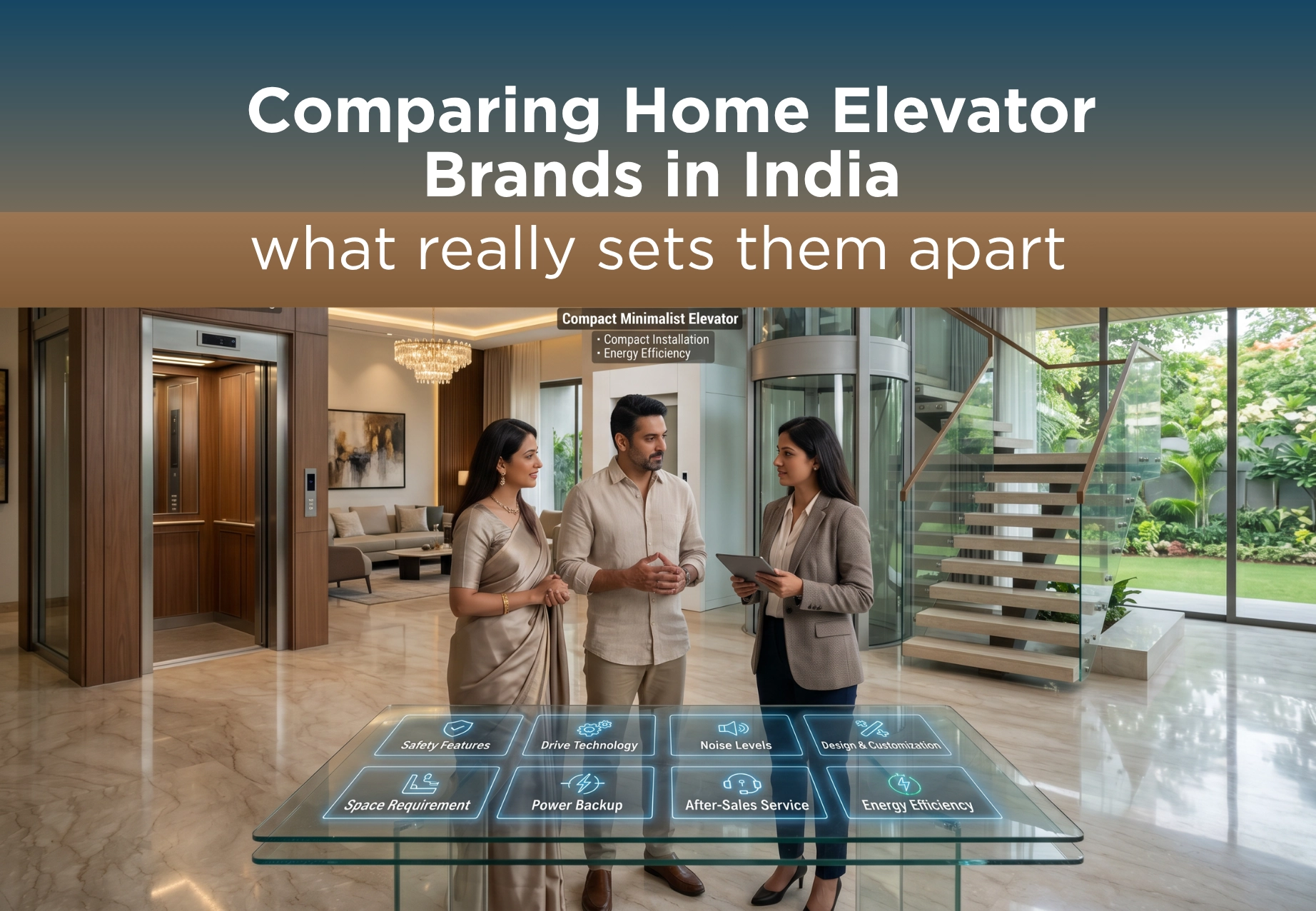
India's home elevator market has grown rapidly over the last decade. Walk into any premium residential neighbourhood in Hyderabad, Bangalore, or Chennai, and chances are at least one home on the street has a lift. The options available to homeowners today in terms of brands, technologies, price points, and designs are wider than they've ever been.
Which also means the decision is harder than it's ever been.
When every brand claims to be the best, how do you actually evaluate them? What separates a home elevator that performs beautifully for twenty years from one that becomes a maintenance headache within two?
This blog breaks down the key factors that genuinely differentiate home elevator brands in India so you can make a decision based on what matters, not what looks good in a brochure.
The drive technology inside a home elevator is arguably the most important factor in its long-term performance and it's one of the least discussed in sales conversations.
There are three primary technologies used in home elevators in India today:
Hydraulic systems use fluid pressure to raise and lower the cabin. They're smooth, but they require a pit, a pump unit, hydraulic fluid maintenance, and are prone to oil leakage over time. They're also less energy-efficient than modern alternatives.
Traction systems use a motor, cables, and counterweights. Reliable in commercial settings, but in home configurations they typically require a machine room, generate more noise, and involve more moving parts that need servicing.
Electric drive systems (MRL — Machine Room Less) are the modern standard for premium home lifts. A compact electric motor with Variable Frequency Drive (VFD) technology powers the cabin with precision, smoothness, and energy efficiency with no pit, no machine room, and significantly fewer mechanical components to maintain.
When evaluating any home lift company in India, ask directly: what drive technology does this elevator use? The answer tells you a great deal about the product's engineering philosophy, its long-term reliability, and its maintenance burden.
Every elevator brand will tell you their lifts are safe. The question is: safe according to whom?
Safety certifications are the only objective measure here. Look for:
European safety standards (EN 81 series) — the global benchmark for elevator safety, covering structural integrity, door systems, electrical safety, and emergency systems. A lift that meets EN 81 norms has been independently validated against a rigorous international framework.
CE Marking — indicates that a product meets European health, safety, and environmental protection standards.
BIS certification — the Bureau of Indian Standards certification for lifts, increasingly relevant as Indian regulatory requirements tighten.
Beyond certifications, look at the specific safety features included as standard:
A brand that lists certifications clearly and explains its safety architecture in detail is a brand that takes safety seriously. Vague references to "world-class safety" with no supporting certification should be a flag.
A home elevator isn't just a utility it lives in your home, visible every day, integrated into your interior design. The quality of a brand's design thinking shows in ways that matter:
Cabin size vs outer footprint ratio — How much usable space does the cabin deliver within the total installation footprint? Poorly designed lifts waste a surprising amount of space in the gap between the outer structure and the usable cabin. The best designs like Brio's BE 360 deliver the largest cabin within the smallest outer footprint in their category.
Shape and form — Most home elevators in India are rectangular. A rectangular cabin works, but it isn't always the most space-efficient or visually interesting option. Brands that have invested in innovative forms like the octagonal BE 360 offer solutions that fit corners better, look more distinctive, and add genuine design value to a home.
Customisation depth — Can you choose your cabin finish, flooring, glass type, lighting, and control panel aesthetics? Or are you picking from two options? The best home elevator brands in India offer meaningful customisation so the lift feels like it belongs in your home rather than being dropped into it.
Glass quality — For panoramic or glass cabin lifts, the glass specification matters. Toughened safety glass, correct thickness, and quality framing determine both aesthetics and long-term performance.
This is a factor that significantly affects the total cost and disruption of an installation yet many homeowners don't ask about it until it's too late.
Different brands and technologies have very different civil work requirements:
A brand that offers a pit-free, machine-room-less, self-supporting installation is giving you something valuable beyond the lift itself; it's giving you minimal disruption, lower civil cost, and a system that doesn't stress your building's structure.
When comparing brands, ask for the complete civil work specification, not just the lift specification. The full picture changes the cost and feasibility calculation considerably.
This is where many home elevator brands, particularly smaller or newer entrants fall short. And it's the factor that matters most after installation day.
Questions to ask every brand:
Service network How many cities do they have trained service technicians in? A brand with sales offices across India but service coverage in only a few cities is a risk for homeowners outside those cities.
Response time commitment What is their committed response time for a service call? 24 hours? 48 hours? Vague? For a home with elderly residents who depend on the elevator, response time is not a minor consideration.
Spare parts availability Are spare parts stocked in India, or do they need to be imported? Imported parts mean longer downtime and higher costs.
AMC (Annual Maintenance Contract) structure What does the AMC cover? What's excluded? Are the rates transparent? A comprehensive, fairly priced AMC is a sign of a brand that wants a long-term relationship with its customers, not just a sale.
Warranty terms What is covered, for how long, and what voids the warranty? Read this carefully.
The best reliable home elevator India brands have robust, responsive, and geographically wide service networks because they know their product needs to perform for decades, not just for the warranty period.
The home elevator market in India has seen an influx of newer brands in recent years, many of them assembling imported components with limited engineering depth or local expertise. Alongside these are established brands both Indian and international with years of installation experience, a large installed base, and a track record of performance.
Heritage matters in this category for a simple reason: an elevator is a long-life product. You want a brand that will still be around with parts, with service, with accountability ten and fifteen years from now.
Look for:
This is a softer factor, but a revealing one. The best home lift companies in India are transparent about:
A brand that answers these questions clearly and upfront rather than deflecting to a sales pitch is a brand that respects your ability to make an informed decision. That approach to the sales process usually reflects how they'll treat you after the sale too.
Having laid out the framework honestly, here's where Brio sits against it and why many homeowners researching how to choose a home elevator in India find their way to Brio.
Technology: Brio's home lifts use advanced electric drive systems with VFD technology pit-free, machine-room-less, energy-efficient, and engineered for smooth residential use.
Safety: Brio's elevators are built to European safety standards with 8 layers of safety certification including ARD, door interlocks, overload sensors, and emergency systems as standard.
Design: The BE 360's octagonal cabin is genuinely unique in the Indian market as the only octagonal home elevator available, with the smallest outer footprint and largest cabin in its category, and panoramic glass as standard.
Civil work: No pit. No machine room. Minimal civil preparation. A self-supporting structure that doesn't impose on your home's existing construction.
Service: Brio has a presence across major Indian cities and an internationally experienced service network, with transparent AMC terms and a committed response structure.
Track record: Brio brings European engineering expertise to the Indian market, with an installation base that spans residential projects across India and internationally in Malaysia, Australia, Indonesia, and the UAE.
Transparency: Every Brio engagement starts with a free site visit, a genuine assessment of your home and needs, with honest recommendations, before any commercial commitment.
The best home elevator brand for your home isn't necessarily the most expensive one, the one with the biggest advertising budget, or the one your contractor recommends because of their margin.
It's the one that:
Measure every brand you evaluate against these criteria including Brio. The one that answers them best is the right one for your home.
The most useful first step isn't a brochure comparison, it's a conversation with a team that knows elevators and knows Indian homes. Brio's free site visit gives you exactly that.
📞 Call: +91 9398113939 🌐 Visit: brioelevators.com