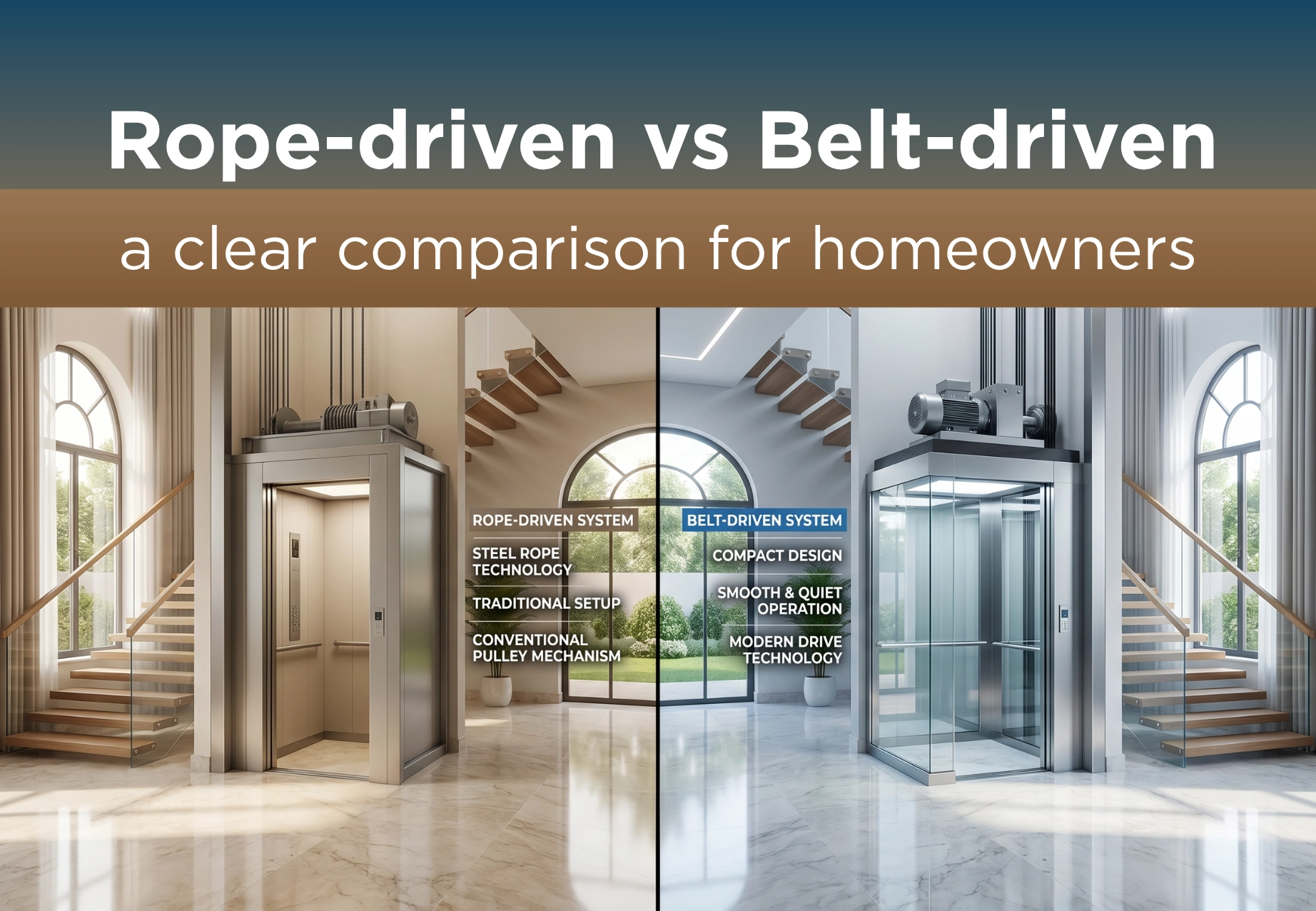
You have decided a home elevator is the right investment for your family. You have even chosen the brand. And then you encounter a question you did not expect rope-driven or belt-driven?
For most homeowners, this is the moment the research goes deeper than expected. Because this is not a question about aesthetics or cabin finishes. It is a question about the heart of your elevator, the mechanism that moves your family between floors, every single day, for the next twenty years.
At Brio Elevators, we build both. The BE-200 rope-driven elevator and the BE-300 belt-driven elevator. And because we build both, we can give you something most elevator companies cannot: a genuinely honest comparison, with no agenda, no bias, and no pressure.
Just clarity. So you can choose right.
A rope-driven elevator uses high-tensile steel wire ropes that run over a traction sheave connected to a gearless motor. As the motor rotates, the sheave pulls the ropes lifting or lowering the cabin with precision and control.
Steel rope technology has been the backbone of elevator engineering for well over a century. It is the technology that built the world's great buildings, earned the trust of global safety regulators, and has been refined through decades of real-world application into one of the most dependable drive systems in existence.
When you ride a rope-driven elevator, you feel that history. There is a solidity to it a composed, authoritative confidence in every movement that comes only from a technology that has been perfected over a very long time.
Brio's BE-200 is a gearless rope-driven MRL elevator, certified under the European Lift Directive 2014/33/EU the highest residential elevator safety standard in the world. It brings that global pedigree directly into your home.
A belt-driven elevator replaces the steel wire rope with a coated steel belt flat, flexible, and engineered with extraordinary precision. The belt contains multiple layers of high-tensile steel cords encased in a polyurethane coating. It wraps around a compact drive sheave connected to a gearless motor moving the cabin with a smoothness and silence that steel ropes, by their very nature, cannot fully match.
Belt technology is a younger innovation developed specifically to address the limitations of rope systems and to meet the demands of modern residential architecture where silence, compactness, and low maintenance are paramount.
When you ride a belt-driven elevator, you feel the difference immediately. The movement is lighter. The sound is closer to silence. The experience feels entirely effortless as though the elevator is barely trying, and that is exactly the point.
Brio's BE-300 is a gearless belt-driven MRL elevator ultra-slim, near-silent, and available in the widest range of customisation options of any Brio model.
Everything else about an elevator can be evaluated on paper. Ride quality can only be felt.
A rope-driven elevator delivers a ride that is smooth, steady, and confident. The movement has weight to it not heaviness, but presence. It starts with purpose, travels with composure, and arrives with precision. For homeowners who want their elevator to feel structurally solid and completely reliable in every journey, the rope system delivers exactly that feeling.
A belt-driven elevator delivers a ride that is lighter, quieter, and almost imperceptibly smooth. The coated belt and compact gearless motor combine to produce a movement so fluid that first-time riders often pause to remark on it. There is no mechanical announcement. There is simply arrival.
Neither ride is inferior. They are different expressions of quality, one authoritative, one effortless.
For families with elderly parents or members who are sensitive to movement, the belt-driven experience tends to feel more reassuring in its gentleness. For homeowners who want a ride that feels engineered to the bone solid, assured, and deeply reliable the rope-driven system answers that completely.
If there is one area where belt and rope technology diverge most meaningfully for the homeowner, it is noise.
A rope-driven elevator is genuinely quiet by any reasonable standard. But it is not silent. The steel ropes moving over the sheave, the subtle mechanical presence of the drive system, the vibrations transmitted through the structure none of it is intrusive, but in a quiet home, it is present. You know the elevator is running.
A belt-driven elevator operates closer to silence than to machinery. The polyurethane-coated belt moves over the drive sheave with almost no friction noise. There is no metal-on-metal contact in the drive mechanism. The sound footprint is so minimal that the elevator announces itself only with the quiet opening of its doors.
For homeowners who have worked hard to create a peaceful, considered atmosphere in their home where evenings are quiet, where mornings are unhurried, where the quality of the space is something you feel as much as seeing a near-silent elevator is not a luxury. It is the only acceptable choice.
If your elevator shaft runs adjacent to a bedroom, a study, or any room where silence matters, the belt-driven BE-300 will serve your home in a way the rope system simply cannot match on this specific dimension.
For most homeowners, maintenance is not something they want on their minds. They want an elevator that works, that is professionally serviced at sensible intervals, and that never becomes a source of stress or unexpected expense.
Understanding rope elevator maintenance honestly is therefore an important part of the decision.
Steel wire ropes require periodic lubrication. Over time and with regular use, they experience natural settling and must have their tension checked and adjusted. At Brio service visits, our engineers inspect rope integrity carefully looking for wear patterns, checking strand condition, and ensuring the ropes are performing precisely as specified.
This is not complicated maintenance. It is standard, well-understood service that Brio's certified technicians handle with complete expertise. But it is a maintenance rhythm that involves the drive system more directly than belt-driven systems do.
A belt-driven elevator requires significantly less attention in the drive system. The polyurethane coating eliminates the need for rope lubrication entirely. The belt does not stretch or require tension adjustment in the way steel ropes do. The internal steel cords are protected from environmental exposure and from the kind of surface wear that ropes accumulate over time.
Over the lifetime of the elevator across ten, fifteen, twenty years of daily family use, belt-driven systems accumulate noticeably lower drive system maintenance requirements. For the homeowner who wants the simplest, most effortless long-term ownership experience, this difference is meaningful.
At Brio, both systems are maintained under our Annual Maintenance Contract by engineers who are trained specifically on each technology. Regardless of which drive system you choose, your elevator will always be in expert hands. But if simplicity of ownership is a priority for you, the belt has a clear advantage here.
This is the question that sits at the heart of the comparison. And at Brio, we answer it the same way every time honestly and completely.
A belt-driven elevator is better in specific, important ways. It is quieter. It demands less maintenance from the drive system. It suits the modern Indian home where space is considered, silence is valued, and long-term simplicity of ownership matters with particular elegance. It is the direction that residential elevator engineering is moving, and the reasons are clear.
A rope-driven elevator is better in its own specific, important ways. It carries the deepest safety pedigree of any drive technology in existence. It handles load requirements with a confidence that comes from over a century of engineering refinement. It is the technology that global safety standards were built around and Brio's BE-200 brings those standards directly into your home with European certification.
So is a belt drive elevator better than rope?
In terms of noise and maintenance simplicity yes. In terms of proven safety track record and engineering authority rope holds its own completely. The better technology is ultimately the one that matches your priorities, your home, and the way your family lives.
Both the BE-200 and BE-300 are MRL Machine Room Less elevators. Neither requires a dedicated machine room. Both are available in masonry and metal shaft configurations, making them equally suitable for new constructions and homes being retrofitted.
The BE-300 belt-driven system offers a marginally slimmer shaft profile due to the compact nature of the belt drive mechanism, an advantage in homes where every centimetre of space is carefully considered.
For standard residential shaft dimensions, both systems install comfortably and without structural compromise.
On safety, Brio makes no distinction between rope and belt. Both the BE-200 and BE-300 are built to the same comprehensive safety architecture.
Progressive safety gear that engages instantly if the cabin exceeds safe travel speed. Automatic Rescue Device for controlled, safe descent during power failure. Multi-beam light curtains on all landing doors. Emergency alarm and two-way intercom accessible from inside the cabin at all times. Overload detection that prevents travel when the rated capacity is exceeded. Backup battery and UPS for continued safe operation during power outages. Biometric access control for complete household security.
Safety is never where we ask our customers to choose. It is a constant identical across every Brio elevator, regardless of drive technology.
Gearless rope-driven MRL elevator. Certified under European Lift Directive 2014/33/EU. Biometric access, RFID panels, multi-beam light curtains, and advanced smart safety systems. A ride that feels solid, composed, and deeply reliable. For homeowners who want the most internationally certified, safety-pedigreed technology in a residential elevator refined to its finest expression by Brio's Indo-Italian engineering.
Gearless belt-driven MRL elevator. Ultra-slim shaft profile. Near-silent operation. Lowest drive system maintenance requirements of any Brio model. The widest range of cabin customisation finishes, textures, lighting, door styles, and smart controls including Alexa voice integration. For homeowners who want an elevator that feels completely effortless, modern, quiet, and so well integrated into the home that it simply becomes part of life.
Not your budget alone. Not the most advanced specification on paper. The one that fits the way your home feels, the way your family moves, and the way you want to live for the next twenty years.
At Brio Elevators, we begin every conversation by listening. We will visit your home.
📞 Call: +91 9398113939 🌐 Visit: brioelevators.com
Q1. What is the difference between rope and belt elevator?
Rope uses steel wire cables that require periodic lubrication and tension checks. The belt uses a coated steel belt that runs quieter, needs minimal lubrication, and demands less maintenance. Same destination, different journey.
Q2. Is a belt drive elevator better than rope?
For silence and low maintenance the belt wins. For proven safety pedigree and a century of engineering trust rope stands strong. Neither is inferior. The better choice depends entirely on how you live and what your home needs.
Q3. Which elevator is better for elderly family members?
Belt-driven elevators. The lighter, smoother, near-silent movement makes every journey more comfortable and reassuring for elderly family members especially those sensitive to vibration or sudden movement.
Q4. Which Brio model is belt-driven?
The Brio BE-300 a gearless belt-driven MRL elevator. Ultra-slim, near-silent, and available in the widest range of cabin customisation options. Built for homeowners who want effortless, quiet, and beautifully refined vertical mobility.
Q5. Which Brio elevator should I choose BE-200 or BE-300?
If you want European-certified safety credentials and a solid, authoritative ride BE-200 rope-driven. If you want near-silent operation, minimal maintenance, and maximum cabin customisation BE-300 belt-driven. Both are exceptional. Brio helps you choose the right one for your home.