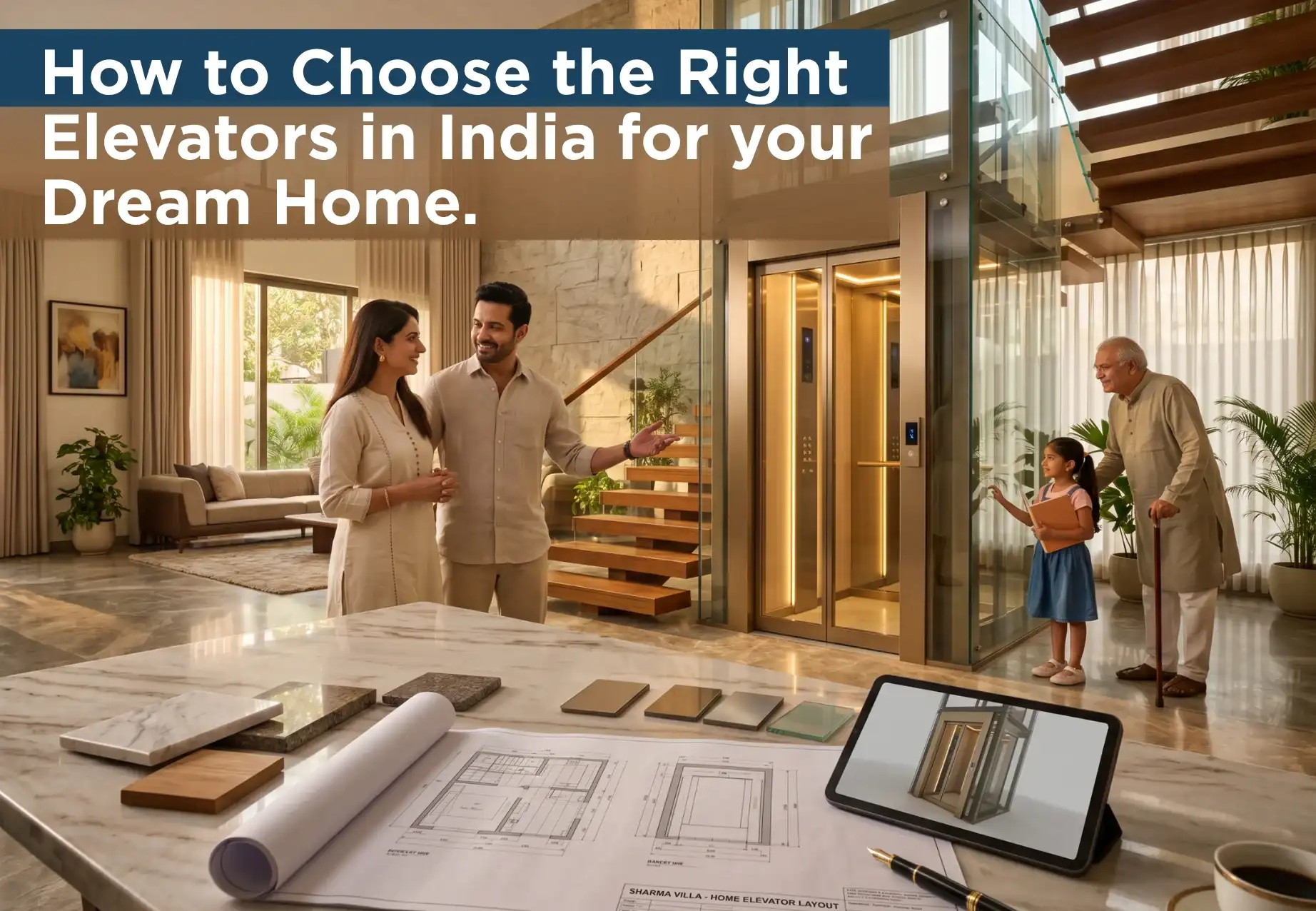
Imagine this.
You spent three years building your dream home. Every tile was chosen carefully. Every room was designed with intention. The kitchen catches the morning light just the way you wanted. The master bedroom has that view you'd been planning for years. The terrace garden turned out exactly as you'd imagined it.
Then, six months after moving in, your father visits for the first time. He's seventy-one. He looks at the staircase connecting your four floors and doesn't say anything. But you see it on his face anyway: the hesitation, the effort it takes him, that quiet resignation of someone who doesn't want to make you feel bad about something you can't easily change now.
Except you could have changed it. You just didn't know enough, early enough, to make that call.
This is for every Indian homeowner who still has time to get this right. And for those who already own a home and are wondering if it's too late to fix what got missed.
It isn't too late. Here's everything you actually need to know.
Most people in India still picture elevators in India as something from a commercial building. A metal box. A mechanical hum. Buttons that light up. Doors that take forever to close.
That's not what a modern home elevator looks or feels like anymore.In 2026, a home elevator is a slim, silent, architecturally considered system that moves between the floors of your home so smoothly and so quietly that the first time someone rides one they genuinely do not believe it has moved until the doors open on a different floor.
It integrates into your home's interior. It responds to your voice. It knows who is authorised to use it. It protects every person inside it with safety systems that activate before you even know something might go wrong.
This is what elevators in India look like when they are done right. And knowing this changes the conversation entirely from should I get an elevator to which one is right for my specific home.
Here is what the companies do not say. What the showroom visits do not cover. And what most homeowners only discover after the elevator is already installed.
This sounds obvious. It's surprisingly ignored.
An elevator doesn't exist in isolation. It exists within your home within your specific floor plan, your ceiling heights, your structural walls, and the way your family actually moves through the house every day.
The elevator that's perfect for a brand-new three-floor villa is not automatically the right elevator for an older two-floor home with thicker walls and lower ceilings. The shaft dimensions are different. The structural approach is different. Even the way each family uses their staircase today is different.
Before you look at a single brochure, have an elevator engineer visit your home. Walk every floor with them. Show them where the elevator will sit. Let them assess the actual structure of the space before any recommendation is made.
At Brio, this is where every single installation begins. Not in a showroom. Not over a phone call. In your home with your space and your family at the centre of every conversation.
If anyone tries to sell you a home elevator in India that requires a machine room ask them one question.
Why?
Machine rooms are a relic of older elevator technology. They exist because traditional drive systems needed a dedicated space typically four to six square feet to house the motor, gearbox, and control panel. A space that serves no purpose other than machinery. A space that is permanently lost from your home.
MRL Machine Room Less eliminates this entirely. All mechanical components integrate within the shaft. Your home keeps every square foot of space that belongs to it.
Beyond space, MRL technology delivers quieter operation, lower energy consumption every month, and simpler maintenance every year. It is not an upgrade. It is the minimum standard for any serious home elevator in India in 2026.
This is the part most elevator conversations skip over. And it is the part that determines how your elevator feels every single day.
Hydraulic -Fluid pressure moves the cabin. The ride is the smoothest available in any residential elevator. There is no jerk at the start. No vibration in the middle. No mechanical announcement at the end. Just a seamless, almost imperceptible movement between floors.
If you have ever stayed in a genuinely fine hotel and noticed how quietly and smoothly the elevator moved, that is hydraulic. Brio's BE-100 delivers this in your home. With Indo-Italian engineering and a five-year warranty on select configurations.
Rope-Driven Gearless- Steel wire ropes and a gearless motor. This is the technology that has moved people in elevators for over a century, refined continuously, held to the world's most rigorous safety standards, and delivered a ride that feels solid, composed, and deeply reliable.
Brio's BE-200 is rope-driven gearless and the only residential elevator in India certified under the European Lift Directive 2014/33/EU. The most internationally credentialled home elevator available in India today.
Belt-Driven Gearless - A coated steel belt replaces the wire rope. The result is near-silence. Genuine, remarkable, stop-and-listen-for-it near-silence. The belt requires no lubrication. It produces no metal-on-metal friction noise. And because there is no gearbox there is no gearbox to service.
Brio's BE-300 is belt-driven gearless and the most popular Brio model in India. Once you ride it, the reason is immediately apparent.
The question is not which technology is best. The question is which technology is best for your home, your family, and the experience you want every time the elevator doors open.
Every elevator company in India will tell you their elevator is safe. Read that sentence again.
Every. Single. One.
The question is not whether a company claims its elevator is safe. The question is whether that claim has been independently verified by a body with no commercial interest in the outcome.
In the world of elevators, the most credible independent verification is the European Lift Directive 2014/33/EU. This is not a domestic Indian certificate. It is the most rigorous residential elevator safety standard applied anywhere in the world issued by an independent European certification body after exhaustive testing of every safety system, every mechanical component, and every aspect of the elevator's design.
Here is a list every Indian homeowner needs to read before signing any elevator agreement.
These safety systems must be standard on any elevator you consider. Not upgrades. Not optional extras. Standard. If any of them is described as an add-on, walk away.
Automatic Rescue Device- When power fails, this activates instantly. The cabin moves to the nearest floor on its own battery. The doors open. Everyone exits safely. In India where power cuts remain a daily reality this is not optional. It is fundamental.
Progressive Safety Gear- A purely mechanical brake that engages the moment the cabin moves too fast. Works without electricity. The last line of defence and the most reliable one.
Multi-Beam Light Curtains- Not one sensor in the middle of the door. A full grid of infrared beams across the entire opening. A hand at the bottom. A foot at the side. A child reaching in from any angle. All detected. The door stops instantly.
Door Interlock -The elevator cannot move with an open door. Physically cannot. This is not a software rule. It is a mechanical impossibility built into the system.
Emergency Intercom - Two-way communication from inside the cabin at any time. Family members are reachable. Emergency services reachable. No one is ever isolated.
Backup Battery and UPS- Lights stay on. Critical systems stay active. Nobody sits in darkness.
Overload Detection- The elevator will not travel if it is carrying more than it should. Period.
All of these are standard on every Brio elevator. In every home. Without exception.
This is the detail most homeowners realize matters only after they see the finished result.
A generic cabin standard panels, standard lighting, standard flooring looks exactly like what it is. A standard installation. In a home that is anything but standard.
The right cabin is designed specifically for the space it will inhabit. Warm wood tones for a home filled with traditional furniture and earthy interiors. Brushed steel and glass for a contemporary home built around clean lines and minimalist design. Soft ambient lighting for a heritage property where the original character needs to be respected, not overshadowed. A custom door style that complements the architecture around it instead of competing with it.
At Brio, every cabin is a conversation not a catalogue selection. A genuine design discussion between our team and the homeowner, resulting in an elevator that doesn't look like it was installed in the home. It looks like it grew from it.
An exceptional elevator installed poorly is a poor elevator. And in India's growing residential elevator market installation quality varies more than any other single factor.
A great installation begins not with tools but with a thorough site assessment. An engineer who has walked every floor of your home, measured every dimension, assessed every structural consideration, and built the installation plan around the specific reality of your space, not a generalised template.
It continues with an installation that respects your home at every stage. Your floors are protected. Your walls are treated with care. Your daily routine is disrupted as minimally as possible.
And it concludes not with a handover on the day the elevator is fitted but with a handover only after every safety system has been tested under real conditions. ARD activated. Door sensors verified physically. Ride quality calibrated to standard. The cabin finished inspected in complete detail. Every test is documented.
At Brio sign-off only happens when every element performs exactly as engineered. Not when the installation is done. When it is done right.
This is the truth that changes everything about how you approach the elevator decision.
You are not buying a product. You are entering a relationship. With a company that will be responsible for the safety and performance of a system your family uses every single day for the next two decades.
Ask yourself before you choose will this company still care about my elevator in year five? In year ten? In year fifteen?
At Brio, the answer is documented and verifiable. Our Annual Maintenance Contract covers biannual professional service visits by certified engineers. Priority response to every service call. Genuine Brio parts are never third-party substitutes. ARD battery testing and replacement on schedule.
We have been in Indian homes since the beginning of this conversation. And we intend to be there for every conversation that follows.
Get Brio involved at the architectural planning stage. The masonry shaft goes into the drawings before the foundation is laid. The elevator becomes part of the home not an addition to it. Permanent. Precisely proportioned. Invisible once finished.
Brio offers a range of shaft solutions, and the right one depends entirely on your space and what you want the elevator to feel like. Some homes call for a shaft that works quietly within the existing structure, fitting into your home without demanding major changes to it. Others suit a shaft that stands out designed to be seen, becoming part of the home's character rather than something hidden away. Our team assesses your home first and recommends the option that genuinely fits your space, not the one that's easiest to sell.
Both situations are handled with equal expertise. Both result in the same Brio standard.
Choosing the right elevator for your home isn't about picking the most expensive option or the one with the longest feature list. It's about choosing one that genuinely fits your home, your family, and the way you live today and twenty years from now.
Take the time to understand your space, ask the right questions about safety, and choose a team that treats your home with the same care you did when you built it. Get that right, and you won't just have an elevator. You'll have a home that finally works for everyone in it at every age, on every floor.
That's a decision worth taking your time over. And it's a conversation worth starting today.
📞 Call: +91 9398113939 🌐 Visit: brioelevators.com
Look for MRL technology, gearless drive system, independent European safety certification, complete safety architecture as standard, full cabin customisation, and a company with a verified after-sales commitment. In 2026 these are not premium expectations. They are the minimum standard for a home elevator that genuinely serves your family.
The BE-100 for the smoothest, most comfortable hydraulic ride. The BE-300 for near-silent operation and Alexa voice control allows elderly family members to call the elevator to any floor without touching a panel. Both carry Brio's complete safety architecture as standard.
Yes completely. Brio's metal shaft solution makes retrofit installation clean, precise, and minimally disruptive. No major civil work. No broken walls. A structural steel shaft assembled on-site and finished to complement the existing home entirely.
Hydraulic delivers the smoothest, quietest ride ideal for families prioritising ride comfort. Rope-driven gearless carries the deepest safety pedigree and the most credible international certification. Belt-driven gearless delivers near-silence, the lowest maintenance requirements, and the most contemporary elevator experience. All three are available in the Brio range.
Because Brio is the only home elevator company in India that combines Indo-Italian engineering, European Lift Directive certification, complete safety architecture on every model, full cabin customisation, four drive technology options, and a genuine lifetime after-sales commitment consistently, highest Installations across all over india. for every kind of Indian family and every kind of Indian home.