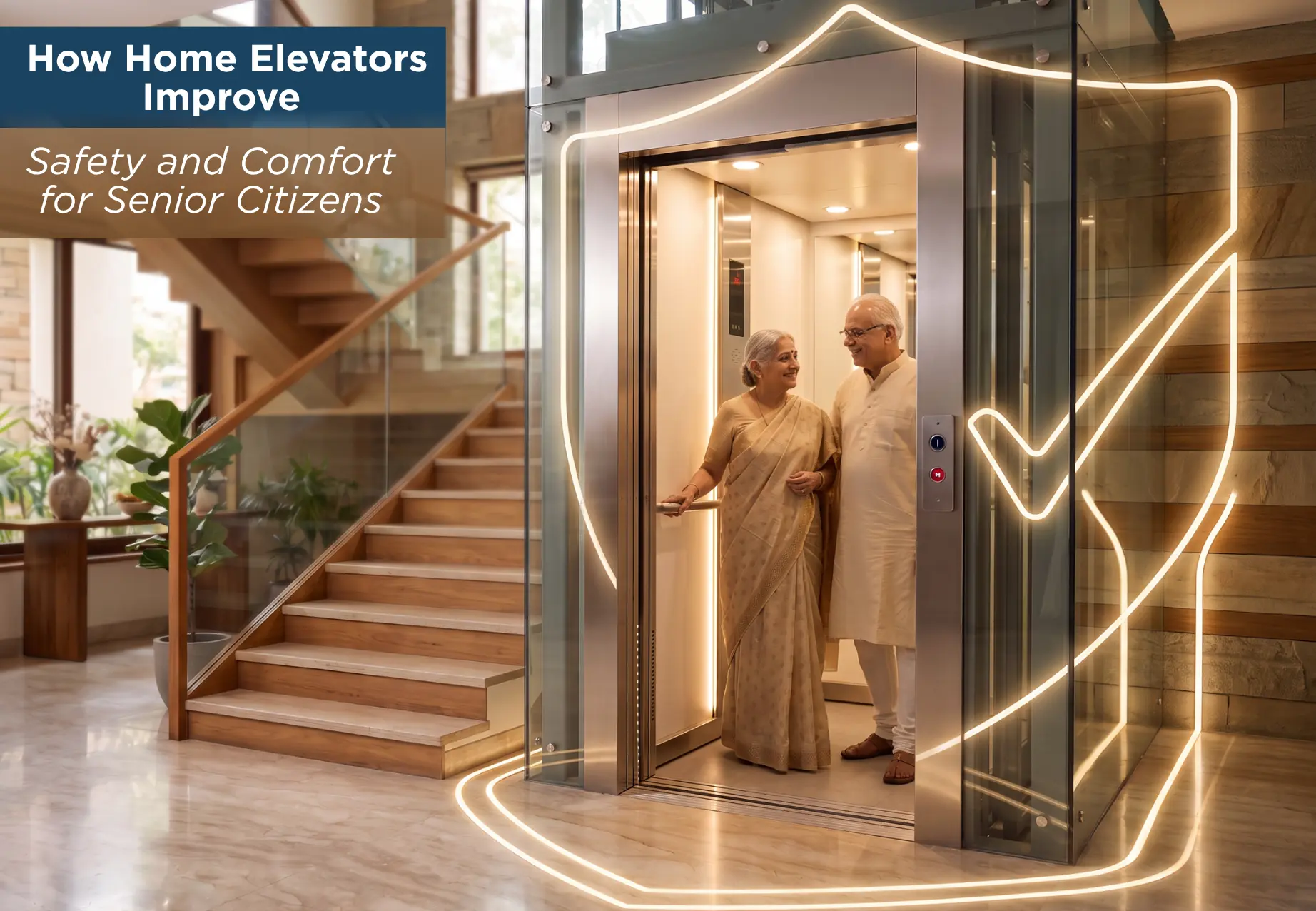
Home Elevators can make everyday movement easier for senior citizens living in duplex homes, villas, and multi-floor houses.
As people grow older, climbing stairs several times a day may become tiring or uncomfortable. A home elevator gives them another way to move between floors without depending on stairs every time.
For families, this is not only about convenience. The right elevator can support easier movement, greater independence, comfortable travel, and simple access to different parts of the home.
In this blog, we explain how Senior Citizens lifts can improve everyday living and what families should consider when choosing an elevator for elderly family members.
Stairs are usually easy to use when we are young, but they can become more difficult with age.
Senior citizens may feel uncomfortable using stairs because of:
A home elevator gives elderly family members another way to reach bedrooms, living spaces, terraces, or other floors.
This can make a multi-storey home easier to use without changing the family's normal lifestyle.
One of the biggest advantages of home lifts is independence.
Without an elevator, an elderly family member may sometimes need another person to help them use the stairs.
With an easy-to-use home elevator, they can move between floors more comfortably on their own, depending on their individual mobility needs.
This can make everyday activities such as going to the bedroom, dining area, prayer room, or terrace much easier.
A well-planned elevator can therefore make more areas of the home accessible throughout the day.
Many families live together across different floors.
The living room may be on one level, bedrooms on another, and other spaces on upper floors.
For senior citizens, moving between these areas several times a day using stairs can become tiring.
House lifts make floor-to-floor movement simple.
Instead of thinking about how many stairs they need to climb, elderly family members can travel comfortably from one level to another.
This helps the entire home remain usable as family needs change over time.
A home elevator should not move roughly.
For senior citizens, smooth starting and stopping can make the ride feel more comfortable.
Important ride qualities include:
A smooth ride is especially important for people who may feel uncomfortable with sudden movement.
This is why families should experience the elevator ride before making a final decision whenever possible.
Senior citizens should be able to enter and leave the elevator comfortably.
The entrance should be planned with enough space and simple access.
Important points include:
If a wheelchair or walking aid is expected to be used, the cabin and entrance dimensions should be planned accordingly.
A professional site assessment can help families select the right cabin size.
The elevator entrance is one of the areas used most frequently.
Modern Home Elevators can include door protection systems that detect people or objects in the entrance area.
For example, light curtain technology can detect an obstruction while the door is operating.
This is useful for:
Families should understand how the elevator door safety system works before selecting a model.
Families may worry about what happens if there is a power failure or another unexpected situation.
A residential elevator should include suitable emergency systems.
Depending on the elevator model, these can include:
These features are especially important when the elevator is used regularly by senior citizens.
The family should also understand how to use the emergency controls before the elevator is handed over.
Technology should make an elevator easier to use, not more confusing.
For senior citizens, controls should be clear and simple.
Useful features may include:
Some modern house lifts may also support smart controls, but basic elevator operation should always remain easy to understand.
The best technology is technology that the entire family can use comfortably.
Lighting is often treated only as a design feature, but it also affects comfort.
A bright and evenly lit cabin can make buttons, doors, flooring, and cabin edges easier to see.
For elderly users, a well-lit elevator can provide a clearer and more comfortable environment.
Families can consider:
The aim should be good visibility without making the cabin feel too bright or uncomfortable.
Families often design homes based on their current needs.
But the home may need to support the same family for many years.
Planning a lift early can make the house more suitable as parents and grandparents grow older.
A home elevator can help families avoid major changes later because movement between floors has already been considered.
This is why Senior Citizens lifts can be part of long-term home planning, not only something installed after mobility becomes difficult.
When selecting a home elevator for elderly family members, families should pay attention to practical features rather than only design.
Important considerations include:
The right combination depends on the home and the person who will use the elevator.
Stairs will always remain part of many homes.
However, senior citizens may not want to use them every time they move between floors.
A home elevator gives them a practical alternative.
For example, an elderly family member may still use the stairs occasionally but prefer the elevator when:
The purpose of the elevator is not to remove the staircase. It is to give the family another comfortable way to move through the home.
The best elevator for senior citizens is not simply the most expensive or largest model.
It should match the actual needs of the person using it.
Before selecting an elevator, families should ask:
These questions help families select an elevator based on real daily use.
At Brio Elevators, home elevator planning starts by understanding the family, property, available space, and everyday usage.
For homes with senior citizens, particular attention can be given to comfort, accessibility, safety systems, and easy operation.
Depending on the selected model, Brio home elevators can include features such as:
Brio also offers different residential elevator solutions for villas, duplex homes, independent houses, and multi-floor residences.
The aim is to create an elevator that fits naturally into the home while making daily movement simpler for the family.
A home elevator is not only a luxury feature.
For a senior citizen, it can make simple daily activities easier.
Going upstairs to rest, visiting another family member, reaching the terrace, or moving between living areas can become more convenient.
For the rest of the family, it can also provide confidence that elderly members have an easier option for moving between floors.
That is what makes a residential elevator valuable in a multi-generation home.
Home Elevators can make multi-floor homes easier and more comfortable for senior citizens.
By reducing regular stair use and providing smooth movement, simple controls, door protection, and emergency support, the right elevator can improve everyday accessibility.
The best solution is one that fits the home, the family, and the actual needs of the senior citizen who will use it.
📞 Call: +91 9398113939 🌐 Visit: brioelevators.com
Yes, home elevators can make movement between floors easier and reduce the need for frequent stair use.
Families should check ride comfort, door safety, easy controls, emergency systems, cabin size, and service support.
Yes, depending on the model and available space, a home lift can be planned with suitable wheelchair-accessible dimensions.
Modern home lifts can include backup and automatic rescue systems that support safer operation during a power interruption.
Yes, many existing homes can accommodate a lift after a proper site and structural assessment.