It's the question that stops most homeowners before they even pick up the phone.
You want a home elevator maybe for ageing parents, maybe for sheer convenience, maybe because your three-storey villa deserves one. But the fear is real: "What if the installation tears up my walls, cracks my flooring, or weakens the structure I've spent years building?"
If you've been told that adding a lift to an existing home means months of construction, dust, drilling, and disruption you've been working with outdated information.
Modern lift installation without structural damage is not just possible. With the right elevator technology, it's the norm.
Here's everything you need to know.
The fear is rooted in how traditional elevators are built and it's not entirely unfounded.
Conventional home lifts in India typically require three things that are very difficult to add to an existing building:
1. A deep pit — Usually 600mm to 1000mm below ground level. In an existing home, digging a pit means breaking through your finished flooring, potentially disturbing your foundation, and significant civil reconstruction.
2. A machine room — A dedicated room, usually at the top of the shaft, to house the motor and drive mechanism. This often means sacrificing a room or building an additional structure on the terrace.
3. A built shaft — Thick brick or concrete walls enclosing the elevator, floor to floor. In an existing home, this can mean major changes to your floor plan, load-bearing wall assessments, and weeks of masonry work.
For a home that's already built, furnished, and lived in this kind of intervention feels invasive. And often, it is. But here's the thing: you don't have to choose a traditional elevator.
The elevator industry has evolved significantly over the last decade, and nowhere more visibly than in retrofit home elevator technology.
Today's best home lifts including Brio's BE 360 and BE 300 are specifically engineered for safe lift installation methods that work around your existing structure, not through it.
Here's what that looks like in practice:
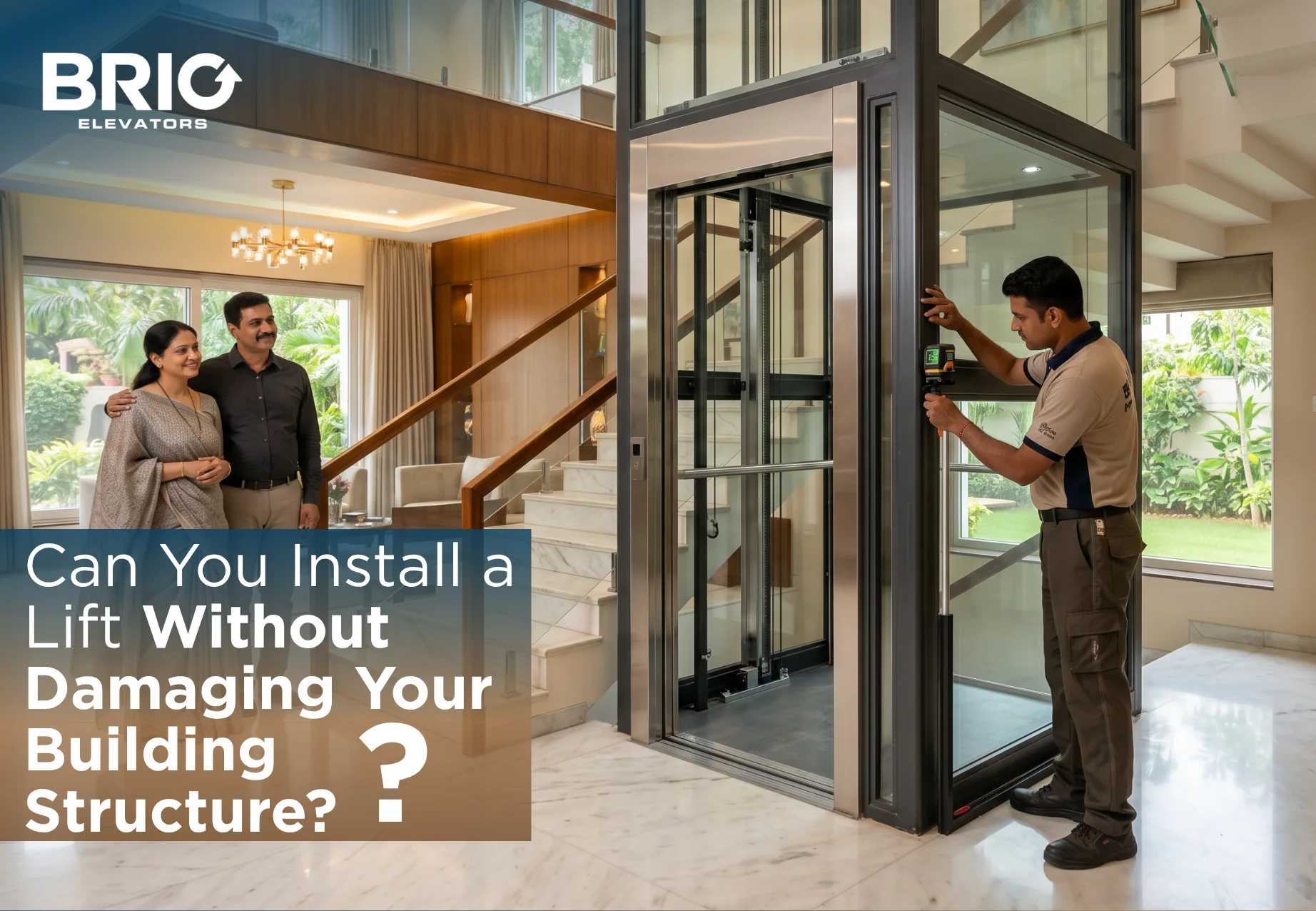
The Brio BE 360 is a pit-free elevator. It doesn't need any floor excavation. The lift system is self-contained from the base up, meaning your existing flooring, foundation, and ground slab remain completely untouched. For homeowners in apartments or homes built on concrete slabs, this is transformational; it removes what was historically the single biggest obstacle to elevator installation in existing houses.
Traditional machine rooms are a thing of the past with modern MRL (Machine Room Less) and electric drive systems. Brio's home lifts house all drive mechanisms within the lift structure itself. No extra room on the terrace, no structural additions to your roofline, no modifications to your existing layout.
Standard elevator installations often require heightened ceiling clearances at the top floor. Brio's design accommodates standard Indian ceiling heights without requiring any structural alteration to your terrace slab or roof.
What about the shaft itself? Brio's home lifts require significantly less civil work than traditional lifts. In many installations, a simple glass or framed enclosure replaces the heavy brick shaft dramatically reducing the load on your building's structure and the time needed for installation.
Let's be specific, because this matters.
When we say no damage home lift installation, we mean:
What you do need is a clearly defined vertical space a corner, a stairwell area, or a designated zone through which the lift will travel floor to floor. Small floor openings are required at each level, but these are clean, precise cuts, not demolitions.
Most homes can accommodate a modern retrofit home elevator in India. Here's a quick checklist to assess your space:
Vertical clearance: Is there a reasonably straight vertical path from the ground floor to the upper floor(s)? It doesn't need to be a pre-existing shaft, just consistent floor alignment.
Available footprint: Modern home lifts need a relatively small footprint Brio's BE 360, for example, has the smallest outer dimension in its category. Even compact homes and apartments can often accommodate it.
Floor slab condition: The lift structure distributes its load across your floor in a controlled way. A Brio site visit will confirm whether any minor reinforcement is needed in the vast majority of cases, none is.
Entry and exit points: Each landing needs a door opening. This is typically a clean cut in a wall, not a structural modification.
Power supply: Brio's electric lifts run on standard single-phase power with no special electrical infrastructure required.
The best way to answer these questions for your specific home is with a professional site visit. Brio offers this for free, across all major cities in India.
Let's say you have a 15-year-old independent house in Hyderabad three floors, built with RCC construction, currently with no elevator provision. Your parents are in their 70s and managing the stairs is becoming difficult.
Here's roughly how a Brio installation would unfold:
Older homes in India built in the 1990s or early 2000s were often constructed with generous room sizes and solid RCC frames. What they weren't built for is a traditional elevator shaft.
The good news is that solid RCC construction actually works in your favour with modern lifts. The structure is stable and reliable. You're not adding load that the building can't handle you're adding a lightweight, self-supporting lift that slots neatly into your existing space.
The key is choosing a lift brand that understands retrofit home elevators in India, the specific challenges of Indian construction norms, ceiling heights, floor-to-floor distances, and space constraints. Brio has been solving exactly these problems across hundreds of homes in Hyderabad, Bangalore, Chennai, and beyond.
Can you install a lift without damaging your building structure? Yes absolutely.
With the right technology and the right team, a safe lift installation in your existing home is clean, fast, and non-invasive. The days of dreading months of construction chaos are behind us.
If anything, the bigger risk is waiting too long whether that's a family member struggling with stairs today, or simply missing the window to add a feature that will elevate your home's value and livability for decades to come.
Brio offers a free site visit with no obligation. Their team will assess your home, answer your questions honestly, and tell you exactly what's possible within your space and budget.
📞 Call: +91 9398113939 📧 Email: sales@brioelevators.com 🌐 Visit: brioelevators.com
Brio Elevators serves homes across Hyderabad, Vijayawada, Bangalore, Chennai, Kerala, Indore, Goa, Dehradun, and more with international presence in Malaysia, Australia(coming soon), Indonesia(coming soon), and UAE(coming soon).