When planning Home Elevators, one question often comes up only after the model is selected:
“Will this lift work with the power supply already available in my house?”
Many homeowners assume that every elevator needs three-phase electricity. That is not always the case.
Today, selected residential elevator technologies can operate on single-phase power, which is commonly available in villas, duplex houses and independent homes. At Brio Elevators, models such as the BE-300 Gearless Grooved Belt, BE-200 Gearless Rope Drive and BE-100 Hydraulic Lift are designed for single-phase operation, while the BE-1000 MRL and BE-360 Circular and Octagonal have different power requirements.
So the better way to plan is not to choose the power supply first. It is to choose the right elevator for the home, understand its electrical requirement, and then prepare the connection accordingly.
This blog explains the difference between single-phase and three-phase power and what homeowners should know before installing a home elevator.
Single-phase electricity is commonly used in homes.
It is normally sufficient for everyday household equipment such as:
A Single phase elevator is designed so that its motor and control system can work with this type of residential power supply.
For a homeowner, the main advantage is simple:
The lift may work with the type of electricity already available in the house.
That can make planning easier.
Three-phase power is commonly used when electrical equipment needs a larger and more balanced power supply.
It is often seen in:
Three-phase electricity can support motors with higher power requirements.
This does not mean three-phase is automatically better for every home elevator.
It simply means it is suitable for different types of electrical loads.
For most homeowners, the difference does not need to become overly technical.
Think of it this way:
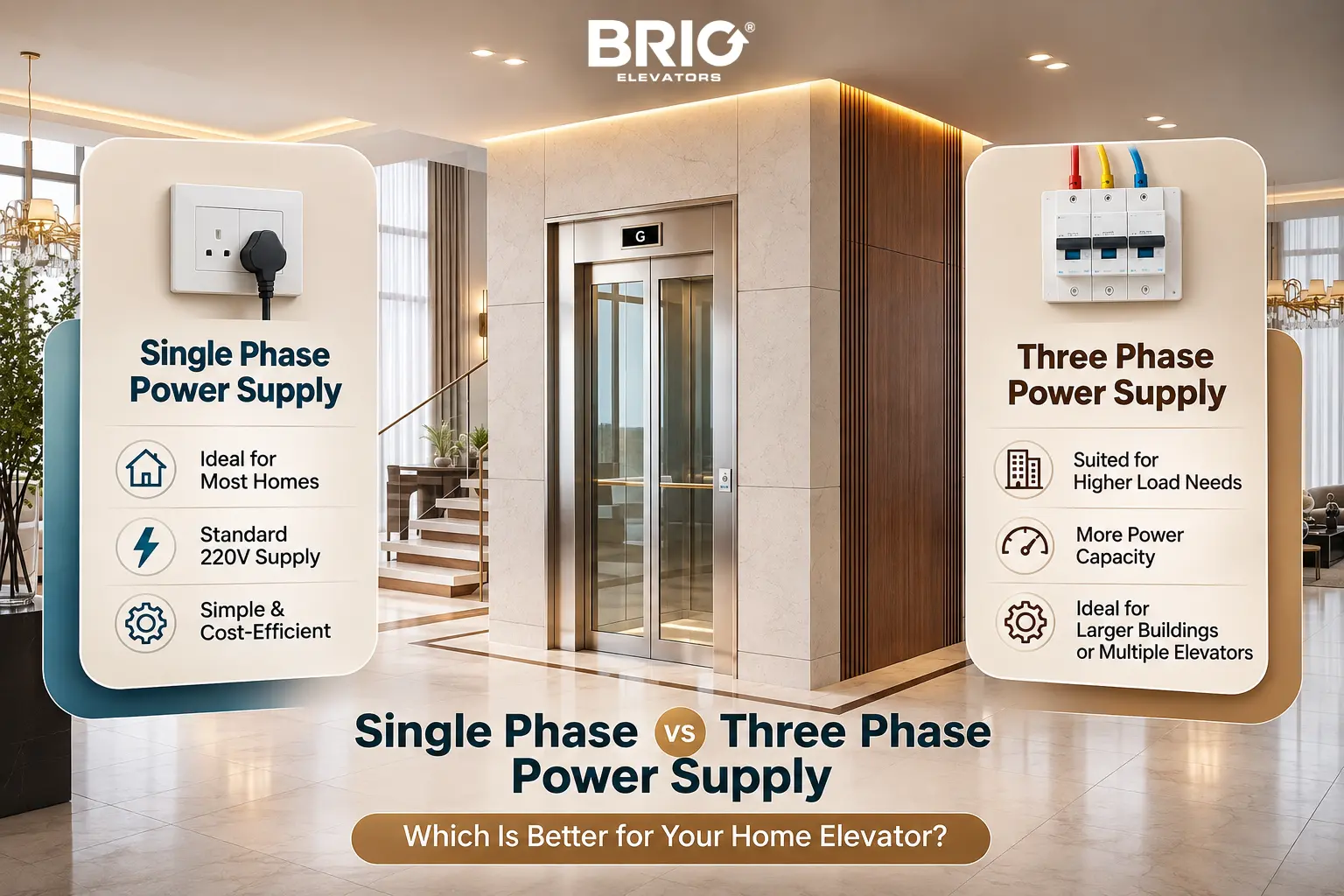
Single phase: Common residential power supply.
Three phase: Suitable for larger electrical loads and higher-power equipment.
If the selected home elevator is designed to work properly on single-phase power, adding a three-phase connection only for the lift may not be necessary.
This is why the elevator model should be selected before making changes to the home's electrical system.
Yes.
Modern motor technology allows selected House elevators to work efficiently with single-phase electricity.
For example, the Brio BE-300 Gearless Grooved Belt Elevator uses a PMSM motor and is designed for single-phase residential operation.
This makes it practical for homeowners who want a modern elevator without automatically moving to a large commercial-style electrical setup.
The exact electrical requirement should still be confirmed for the selected model and project.
Single-phase elevator technology can offer several practical advantages for residential customers.
Many independent houses and villas already use single-phase electricity.
If the elevator model supports it, the existing residential setup can make installation planning simpler.
If a customer already has a suitable single-phase supply, there may be less need to upgrade the property only because a lift is being added.
A home elevator is not normally used continuously like a lift in a busy shopping centre or office building.
Residential use is usually lighter and more controlled.
This makes modern single-phase elevator technology suitable for selected home applications.
Three-phase power may still be the right choice for certain elevators.
For example, it may be required when the lift has:
The important thing is to follow the requirements of the exact elevator model.
Homeowners should not assume that every lift needs three phases, but they also should not try to run a three-phase elevator from an unsuitable supply.
Not necessarily.
Power supply type and elevator performance should not be confused.
A modern motor designed for single-phase residential use can still provide smooth and reliable movement for the application it was designed for.
What matters is whether the complete elevator system has been engineered for:
A properly designed Single phase elevator is not simply a three-phase elevator connected to a smaller power source.
The motor and controls are designed around that electrical system.
Older elevator systems often required larger electrical arrangements.
Modern motor technology has changed this.
For example, PMSM stands for Permanent Magnet Synchronous Motor.
This type of motor can provide controlled movement while using power efficiently.
In Brio's BE-300, the PMSM motor works together with the Gearless Grooved Belt system.
This supports smooth movement while allowing the model to operate on a residential single-phase supply.
For homeowners, the benefit is not the technical name of the motor.
The benefit is that modern engineering can make a home elevator easier to integrate into a residential property.
The electricity used by an elevator depends on more than whether the supply is single phase or three phase.
Consumption can depend on:
A home elevator is generally used only when someone needs to travel between floors.
It does not run continuously all day.
So instead of asking only whether the lift is single phase, customers should ask:
“How much power does this particular elevator use during normal home operation?”
That gives a more useful answer.
The elevator should have a properly planned electrical connection.
Even when a lift operates on single-phase power, the electrician and elevator technical team should coordinate the electrical work.
The requirement may include:
The exact specification depends on the elevator model.
It is always better to complete the electrical work according to the lift manufacturer's technical requirement rather than making assumptions.
That is not a problem.
Many larger villas already have three-phase electricity because the house itself has a high electrical load.
The elevator technical team can check the available supply and explain how the selected model should be connected.
Having three-phase electricity does not mean you must choose only a three-phase home elevator.
The elevator should still be selected according to the home and its intended use.
If the house is still under construction, this is the best time to discuss the elevator's electrical requirement.
Tell the architect and electrical contractor which elevator model you are considering.
This allows them to plan:
Planning this early avoids unnecessary changes after the house is almost complete.
There is no single answer for every elevator.
For many residential projects, a Single phase elevator can be a practical choice because it suits normal home electrical infrastructure.
Three-phase power may be better when the selected elevator requires greater electrical capacity or is designed specifically for that supply.
The better question is not:
“Which power supply is stronger?”
“Which power supply is correct for the elevator I am installing?”
That is what homeowners should focus on.
At Brio Elevators, selected home elevator technologies are designed to work on single-phase power, making them practical for villas, duplex houses and independent homes.
Brio's single-phase home elevator options include:
These models can work with residential single-phase power, helping homeowners avoid unnecessary electrical upgrades where the existing supply is suitable.
The BE-1000 MRL and BE-360 Circular and Octagonal have different power requirements and are not included in Brio's single-phase home elevator range.
For customers, the important point is to confirm the electrical requirement of the selected Brio model before planning the final power connection.
Before choosing between different Home Elevators, ask the company:
These questions will give you a much clearer idea of the real electrical requirement.
No.
The best elevators are not decided by the number of electrical phases.
A good home elevator is one that is correctly designed for the property, family and expected usage.
For one home, that may be a modern single-phase system.
For another project, three-phase power may be more suitable.
The correct engineering matters more than simply choosing the larger electrical supply.
The right power supply for Home Elevators depends on the elevator technology you choose.
At Brio Elevators, the BE-300 Gearless Grooved Belt, BE-200 Gearless Rope Drive and BE-100 Hydraulic Lift are designed to work on single-phase power, making them practical options for many villas, duplex houses and independent homes.
The BE-1000 MRL and BE-360 Circular and Octagonal have different power requirements and are not part of Brio’s single-phase range.
So, homeowners should not change their electrical connection before choosing the lift. First select the right Brio model, understand its power requirement, and then plan the electrical setup accordingly.
For most residential projects, choosing the correct elevator technology is more important than simply deciding between single-phase and three-phase power.
📞 Call: +91 9398113939 🌐 Visit: brioelevators.com
Yes, selected modern home elevators are specifically designed to operate on single-phase residential power.
The Brio BE-300 Gearless Grooved Belt Elevator uses a PMSM motor designed for single-phase residential operation.
No, the correct supply depends on the elevator's motor, capacity, travel and intended application.
Electricity consumption depends on the complete elevator technology, motor efficiency, travel and usage rather than phase type alone.
Not necessarily. First select the elevator and confirm its electrical requirement before making any changes to your home supply.

