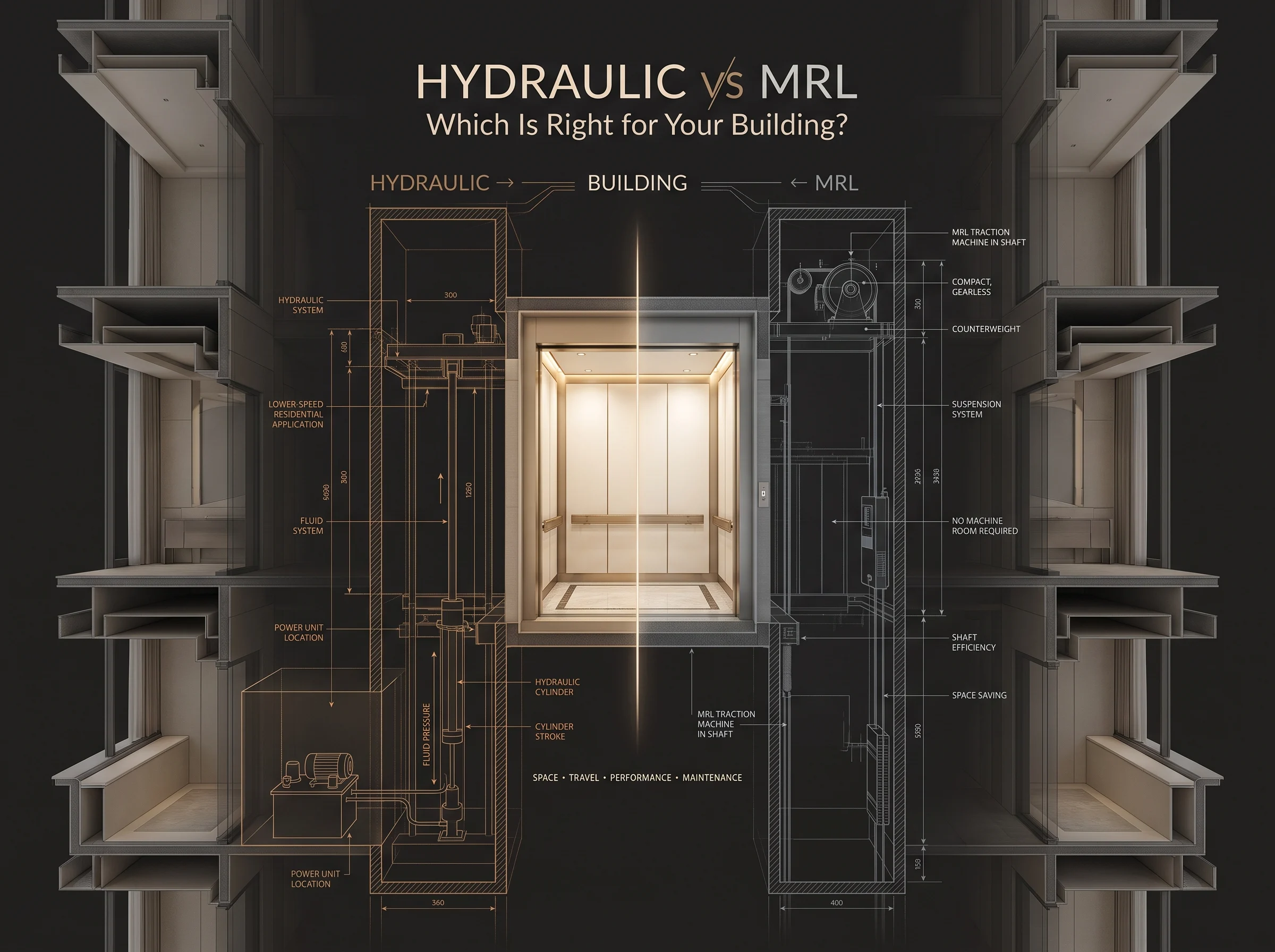
A Hydraulic lift and an MRL lift can both be good choices, but they work in different ways and are suitable for different types of buildings.
A hydraulic lift uses hydraulic pressure to move the cabin, while an MRL, or Machine Room Less lift, normally uses a traction or gearless drive system with the main equipment placed within or around the lift shaft instead of a separate machine room.
So which one should you choose?
The answer depends on your building height, available space, expected usage, ride requirements, energy needs, and long-term maintenance.
In this blog, we explain the difference between hydraulic and MRL elevators in simple language so homeowners, builders, and architects can make a better decision.
A Hydraulic lift uses hydraulic power to raise and lower the elevator cabin.
The system normally uses a hydraulic unit, oil, cylinder, and piston. Pressure created by the hydraulic system helps move the lift upward, while controlled release of pressure allows it to travel downward.
Hydraulic elevators are commonly considered for:
A Hydraulic lift for home can be useful when smooth travel and low-rise operation are important.
MRL means Machine Room Less.
Traditional elevator systems may require a separate room to house the motor and other equipment. An MRL lift is designed so that major drive equipment can be placed within or close to the elevator shaft.
This helps reduce the need for a traditional machine room.
MRL elevators are commonly used in:
An MRL lift for home can also be suitable when homeowners want efficient use of building space and higher travel requirements.
The basic operation of a hydraulic elevator is easy to understand.
When the lift needs to move upward, a pump pushes hydraulic fluid into a cylinder.
This pressure moves a piston, which raises the elevator cabin.
When the lift moves downward, the system controls the release of hydraulic fluid and allows the cabin to descend smoothly.
The system is known for controlled movement and can work well in buildings with limited travel height.
An MRL elevator normally uses a traction-based drive system.
The motor moves ropes, belts, or another drive arrangement to move the cabin between floors.
Instead of placing the motor inside a large separate machine room, the system is designed to make better use of the elevator shaft area.
Modern gearless MRL systems can provide:
This makes MRL technology useful in many modern buildings.
Space is one of the main reasons people compare hydraulic and MRL lifts.
A hydraulic system needs space for hydraulic equipment such as the pump and control unit.
The exact arrangement depends on the elevator design.
Some systems can be planned compactly, but the hydraulic equipment still needs a suitable location.
An MRL lift is specifically designed to reduce or remove the need for a conventional separate machine room.
Major equipment is positioned within or around the lift shaft.
For buildings where usable floor space is valuable, this can be an important advantage.
However, shaft dimensions, pit, and headroom should always be checked for the specific elevator model.
Both technologies can work well in residential buildings.
The right choice depends on your house.
A hydraulic system may be suitable when:
An MRL system may be suitable when:
Instead of selecting only by technology name, a site inspection should be carried out first.
Both systems can provide comfortable travel when properly designed and installed.
A hydraulic lift is known for controlled movement, especially in low-rise applications.
Modern MRL lifts using gearless technology can also provide very smooth acceleration and stopping.
Ride comfort depends on more than the drive system.
It can also depend on:
Whenever possible, experience the elevator before making a final decision.
In general, MRL traction systems can support higher travel speeds than many hydraulic systems.
For a small home with only a few floors, this difference may not be very important.
But for buildings with more floors, speed becomes more noticeable.
An MRL lift may be more practical when:
For low-rise homes, moderate speed may already be enough for comfortable daily use.
Energy use depends on the actual elevator model, capacity, travel, and frequency of use.
Hydraulic systems use electrical power to operate the hydraulic pump when lifting the cabin.
Modern MRL elevators often use efficient gearless motors and control systems.
For buildings with frequent elevator movement, an MRL system may provide an advantage in energy efficiency.
However, homeowners should ask for the actual electrical requirements of the elevator being considered instead of assuming every MRL or hydraulic system performs the same way.
Noise is important, especially when an elevator is installed near bedrooms or living areas.
Both technologies can be quiet when designed and installed correctly.
The overall sound level can depend on:
For residential use, ask the elevator company where the major equipment will be located and whether you can experience a working installation.
Every elevator requires regular maintenance.
A hydraulic system may require inspection of:
Oil condition and possible leakage should also be checked during regular maintenance.
An MRL system may require inspection of:
Neither technology should be considered maintenance-free.
The quality of service support is just as important as the technology itself.
Building height is an important deciding factor.
Hydraulic elevators are generally more suitable for lower-rise applications.
MRL systems offer greater flexibility when the building has more floors or greater travel height.
For example, a small villa may work well with a hydraulic system, while a multi-floor residential or semi-commercial property may benefit more from an MRL solution.
The correct answer depends on:
Both hydraulic and MRL elevators should include suitable safety systems.
Depending on the elevator model, these may include:
Homeowners should not assume that one technology is automatically safer than the other.
Safety depends on the complete elevator system, components, installation, testing, and maintenance.
A Hydraulic lift can be a practical choice when:
For certain villas and independent homes, hydraulic technology can provide a simple and comfortable elevator solution.
An MRL lift can be a strong option when:
For modern villas and multi-floor buildings, MRL technology can offer a good balance between performance and space efficiency.
Installing an elevator in an existing building requires careful planning.
The technical team needs to check:
In some existing buildings, one technology may fit the available space better than the other.
This is why choosing between a Hydraulic lift for home and an MRL lift for home should happen only after a site inspection.
For a new building, homeowners and builders have more flexibility.
The elevator can be planned along with the architecture.
This makes it easier to coordinate:
Discussing the elevator during the design stage can prevent unnecessary changes later.
Before making the final decision, ask your elevator company:
Clear answers to these questions can make the comparison much easier.
There is no single winner for every building.
A Hydraulic lift can be a good choice for low-rise buildings where controlled movement and moderate usage are important.
An MRL lift can be better suited to buildings that need more travel, efficient space use, higher performance, or frequent operation.
The best elevator is the one that matches the property.
Instead of asking:
“Which technology is better?”
Ask:
“Which technology is better for my building?”
That is the more useful question.
At Brio Elevators, the elevator solution is selected according to the building rather than recommending the same technology for every project.
Brio's residential and semi-residential range includes solutions using different elevator technologies, including hydraulic and MRL options for suitable applications.
Before recommending a lift, factors such as these are considered:
The aim is to help customers choose an elevator that provides the right balance of space, comfort, technology, safety, and long-term performance.
Choosing between a Hydraulic lift and an MRL lift depends on your building, not simply on which technology sounds more advanced.
Hydraulic lifts can work well for low-rise applications, while MRL lifts can offer advantages for greater travel, efficient space usage, and more frequent operation.
A proper site inspection and technical assessment are the best ways to decide which lift is right for your property.
📞 Call: +91 9398113939 🌐 Visit: brioelevators.com
A hydraulic lift uses hydraulic pressure for movement, while an MRL lift normally uses traction or gearless technology without a conventional separate machine room.
Yes, hydraulic lifts can be suitable for low-rise homes where moderate travel and smooth operation are required.
Yes, MRL lifts can work well in villas and multi-floor homes where efficient space use and higher travel performance are important.
MRL systems are generally more suitable when a building has greater travel height or more floors.
Both require regular professional maintenance, but the components and maintenance requirements are different for each technology.