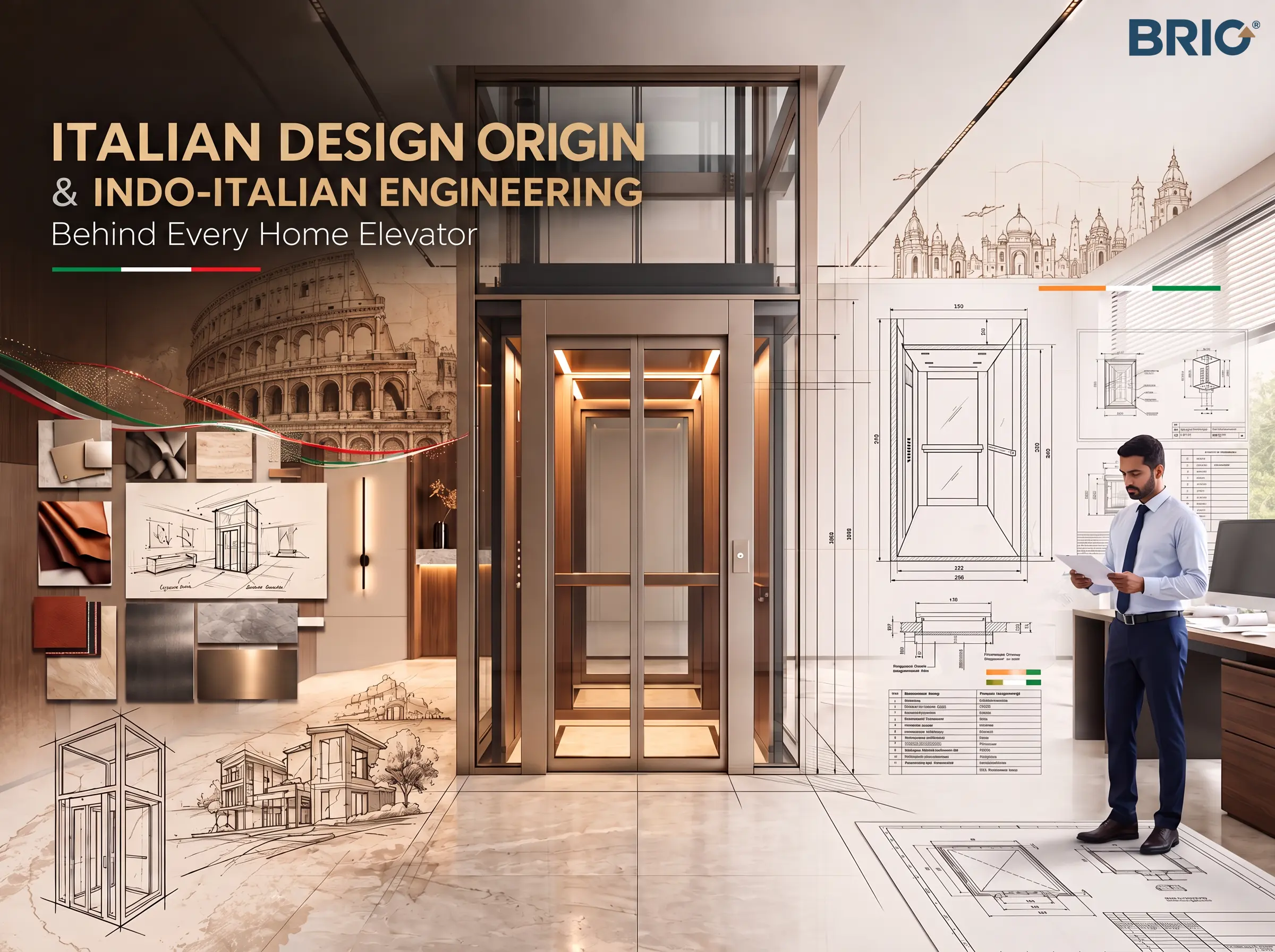
An Italian Home Elevator is often associated with elegant design, refined finishes, modern engineering, and attention to detail.
Brio Elevators brings this Italian design influence together with engineering, manufacturing, installation, and service suited to Indian homes.
This is why Brio describes its approach as Indo-Italian.
It does not mean that every component inside every Brio elevator is manufactured in Italy. Modern elevators can use technologies and components sourced from different countries.
What matters is understanding the complete product clearly: its design influence, engineering standards, components, manufacturing, installation, safety systems, and after-sales responsibility.
In this blog, we explain what the Italian origin and Indo-Italian approach mean for Brio Elevators.
For Brio, the Italian connection is mainly about design thinking, engineering influence, aesthetics, and European standards.
Italy is known worldwide for combining technology with design.
This influence can be seen in areas such as:
Brio applies this design approach while developing elevator solutions suitable for Indian villas, duplex homes, and multi-floor residences.
This combination creates the foundation of Brio's Indo-Italian elevator approach.
Indo-Italian does not simply mean an elevator is imported from Italy.
It describes a combination of international design thinking and local execution.
For Brio, this can include:
This approach allows the elevator to combine international design influence with the practical requirements of Indian homes.
A residential elevator is very different from a commercial lift.
In a hotel, mall, or office, the elevator is mainly functional.
Inside a home, the elevator also becomes part of the interior.
That is where Italian elevator design becomes important.
Italian-inspired residential design usually focuses on simplicity rather than unnecessary decoration.
The elevator can become part of the home's architecture through details such as:
The aim is to make the elevator feel like it belongs inside the home.
Italian design is not only about making something look beautiful.
Good design should also make a product comfortable and easy to use.
For a home elevator, this means thinking about:
A well-designed elevator should look good while also making everyday movement simpler.
This balance between form and function is an important part of Brio's design approach.
Design is only one part of the Brio story.
Brio also looks toward European engineering practices and technical standards when developing its elevator solutions.
European elevator engineering places strong importance on areas such as:
These areas are important because a home elevator is used by family members every day.
A premium design should always be supported by proper engineering.
No.
This is an important point to explain clearly.
Modern elevators can use components from different countries depending on the model, technology, and project.
Brio's elevator ecosystem can involve products and components connected with markets such as:
For example, one elevator may combine European-standard components with locally manufactured parts and internationally sourced technology.
The country where one component is manufactured does not by itself define the complete quality of an elevator.
Homeowners should instead look at:
Transparency about sourcing is more useful than simply placing one country label on the complete elevator.
An elevator contains many specialised parts.
These can include:
Different manufacturers around the world specialise in different technologies.
Because of this, global sourcing is common in modern engineering.
The important question is not whether every component comes from the same country.
The better question is:
Does the component meet the required technical, safety, and performance standards?
An elevator designed for Indian homes must also consider local conditions.
These can include:
Brio combines international design thinking with these practical requirements.
This helps create elevators that are not simply imported ideas but solutions planned around real Indian homes.
Every homeowner has a different design preference.
Some may prefer a completely minimal cabin.
Others may want a more luxurious look.
Depending on the elevator model, Brio offers customisation possibilities such as:
This flexibility allows the elevator to carry an Italian-inspired visual language while still matching the homeowner's individual interior style.
An attractive elevator should also be a safe elevator.
This is especially important in homes where the lift may be used by:
Depending on the model, Brio elevator solutions can include safety systems such as:
Design may attract attention first, but safety should remain one of the main factors when choosing a home elevator.
One of the biggest advantages of an Indo-Italian approach is that the customer does not depend only on an overseas manufacturer.
The elevator is supported locally by Brio.
That includes areas such as:
For homeowners, this is important because an elevator remains part of the property for many years.
International design becomes more valuable when it is supported by reliable local service.
Before buying an elevator, customers should ask clear questions.
These include:
These questions provide a much clearer understanding than simply asking whether an elevator is "Italian" or "Indian."
Customers deserve to know what they are buying.
This includes knowing:
Brio's Indo-Italian positioning should therefore be understood as a combination of Italian design influence and European engineering thinking with Indian execution, support, and selected manufacturing.
Clear information builds more confidence than broad origin claims.
Brio Elevators brings together global design thinking and local understanding.
Its approach focuses on:
The goal is to provide a home elevator that looks refined, performs smoothly, and works naturally within the Indian residential environment.
The strongest part of the Indo-Italian approach is not simply where a product comes from.
It is how different strengths are brought together.
Italian design contributes refinement and visual simplicity.
European engineering principles contribute to technical discipline.
Indian expertise contributes to local installation, customisation, and service.
Together, these elements create an elevator experience designed around modern Indian homes.
Brio's Italian origin story is best understood through its Italian design influence and Indo-Italian engineering approach.
Rather than claiming that every elevator component is made in one country, Brio combines international design, global technology, suitable components, Indian execution, and local service.
For homeowners, what matters most is clear information about design, engineering, sourcing, safety, installation, and long-term responsibility.
Italian-inspired design. Global engineering. Built around Indian homes.
📞 Call: +91 9398113939 🌐 Visit: brioelevators.com
Brio follows an Indo-Italian approach that combines Italian design influence and European engineering thinking with Indian execution and support.
No, components can be sourced from different countries depending on the elevator model and technical requirements.
It refers to combining Italian-inspired design and international engineering standards with solutions, installation, and service suited to Indian homes.
Italian-inspired elevator design focuses on refined aesthetics, clean lines, premium materials, simple controls, and integration with modern interiors.
Understanding origin, sourcing, standards, installation, and service helps homeowners know exactly what they are purchasing.