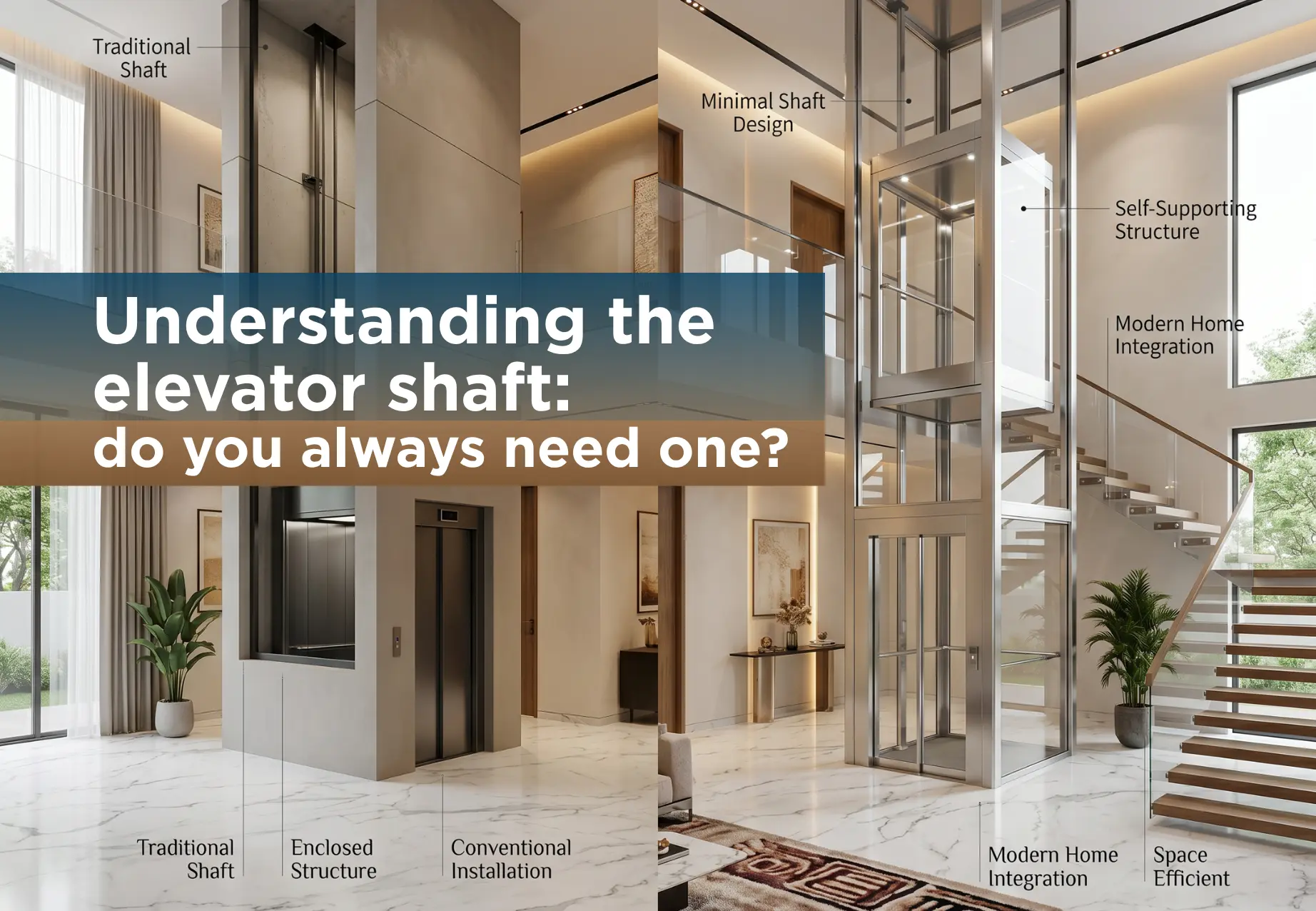
When homeowners begin thinking about adding an elevator to their home, the first question is rarely about motors or mechanics. It's about space, aesthetics, and disruption. Will this work in my home? Will it look right? Will construction turn my life upside down? And most importantly do you always need an elevator shaft?
Let's begin with the foundation: what is an elevator shaft?
An elevator shaft, also known as a hoistway, is the vertical enclosure that the elevator car travels through between floors. It's the dedicated space built into the structure of your home that houses the guide rails, mechanical components, and safety systems that make an elevator function smoothly, silently, and safely.
For decades, the shaft was simply accepted as a given. You wanted an elevator, you built a shaft. End of conversation.
But today's homeowners are different. They are more informed, more design-conscious, and more intentional about how their homes are built and modified. They want solutions that respect their space, complement their interiors, and align with their vision of a well-designed home not just a functional one.
That's exactly why the question of the shaft has become so important.
Yes, a shaft is needed. But here is what that actually means for you and it is far less intimidating than you think.Brio does not ask you to rearrange your life around a shaft. Brio designs a shaft around your life.If your home is under construction, the shaft goes in quietly alongside everything else. You will not even notice it happening.If your home is already built and standing, Brio's metal shaft solution means no major civil work, no broken walls, no weeks of disruption. A structural steel shaft, precision-fitted to your space, finished to complement your interiors assembled in as little as one to two weeks.Either way, you get a proper elevator. Not a temporary fix. Not a compromise. A real, permanent, beautifully integrated home elevator.
A masonry shaft is the traditional choice built using brick, concrete, or stone as part of your home's permanent structure. For homeowners who are building a new villa, duplex, or independent home, a masonry shaft is the gold standard. It integrates completely with the architecture, becomes invisible once finished, and is designed to last as long as the building itself.
There is something deeply reassuring about a masonry shaft. It speaks to permanence, craftsmanship, and a long-term vision for the home. Homeowners who choose a masonry shaft are typically those who plan ahead who see their home not as a temporary arrangement but as a legacy. Brio's masonry shaft installations are engineered with exacting precision, ensuring clean lines, structural integrity, and a finish that feels entirely intentional.
For homeowners who are retrofitting an existing home or those who prefer a cleaner, faster installation without heavy civil construction Brio's metal shaft is the answer. Fabricated from high-quality structural steel and finished with care, a metal shaft can be assembled on-site with far less disruption than traditional masonry work.
The metal shaft is the choice of the modern, practical homeowner who refuses to compromise on quality. It is strong, precise, and when designed by Brio, surprisingly refined in appearance. With the right cladding options, including glass panels, composite finishes, and custom powder coatings, a Brio metal shaft can become a visual feature of your home rather than something to hide.
For retrofits in homes across all over India, Brio's metal shaft solution has allowed thousands of families to add vertical mobility without turning their home into a construction site.
For homeowners who choose either shaft type, the decision goes beyond engineering. A well-designed shaft, integrated thoughtfully into the architecture of a home, speaks to a certain kind of professionalism and taste. It tells a story about a homeowner who plans ahead, who invests in infrastructure that will serve their family for generations, and who understands that the finest homes are built with as much thought for what is behind the walls as what is in front of them.
The shaft becomes invisible but its presence is felt in every smooth, silent, perfectly levelled journey between floors.
Every Brio elevator is designed to work in harmony with both shaft types. Here is a glimpse of what moves inside them:
BE-360 India's first hybrid hydraulic elevator with a 360° panoramic cabin. A centrepiece for villas and penthouses. Requires no deep pit or bulky machine room ideal for both new builds and retrofits.
BE-300 A gearless belt-driven elevator with MRL (Machine Room-Less) configuration. Ultra-slim, ultra-silent, and crafted with wide customisation options to match your interiors perfectly.
BE-200 A gearless rope-driven elevator certified under European Lift Directive 2014/33/EU. Equipped with biometric and RFID access, multi-beam light curtains, and smart safety systems for those who demand the highest standards.
BE-100 Brio's premium hydraulic home lift built with German engineering and manufactured in Italy. Whisper-quiet, minimal maintenance. The choice for families who want effortless, reliable comfort for decades.
Each of these models can be fitted within a masonry or metal shaft and each can be customized in cabin finishes, lighting, door styles, and controls including Alexa voice integration.
For the discerning homeowner, time matters not because of impatience, but because of respect for the home environment. Disruption has a cost beyond the financial. It affects daily rhythm, comfort, and the carefully maintained atmosphere of a well-run household.
So how long does it take to install an elevator shaft?
For a new construction project, the shaft is built concurrently with the home itself. There is no disruption, no afterthought, no compromise. The elevator simply becomes part of the home.
For a retrofit, the typical timeline runs between six and fifteen weeks from initial assessment to final commissioning covering planning, permit approvals, shaft construction, elevator installation, and safety inspections.
Masonry shaft construction in an existing home generally takes twelve to sixteen weeks. A metal shaft, owing to its modular, prefabricated nature, can be completed in as little as one to two weeks significantly reducing the total project duration.
At Brio Elevators, we approach every timeline with the same professionalism you would expect from a premium home partner. Our team works around your schedule, communicates clearly at every stage, and treats your home with the care it deserves.
The elevator shaft question is ultimately not a technical one. It is a personal one.
It asks you to consider how you live, what you value, and what kind of home you want to inhabit. Some homeowners want the permanence and prestige of a masonry shaft, an investment built into the bones of their home. Others want the speed and flexibility of a metal shaft precise, clean, and modern.
Neither choice is wrong. Both reflect a certain kind of taste. A preference for doing things properly, with attention and intention.
At Brio Elevators, we don't believe in one-size-fits-all solutions. We believe in listening carefully, understanding your home and your lifestyle, and recommending what genuinely fits. Our clients are people who care deeply about quality and so do we.
Brio Elevators is India's first Indo-Italian elevator company, a distinction that means something. It means our products are held to European engineering standards while being designed for the realities of Indian homes, Indian weather, and Indian lifestyles.
Trusted in 2,000+ homes across India. Present in 12+ cities. Certified under European safety standards. And backed by a team that genuinely believes that an elevator is not just a convenience it is one of the finest details of a well-designed life.
End-to-End Service From site survey and design to installation and AMC support. Indo-Italian Engineering European safety standards, adapted for Indian homes. Full Customisation Cabin finishes, lighting, textures, door styles, and smart controls. Both Shaft Types Masonry and metal, expertly installed for new builds and retrofits alike.because we stand behind everything we build.
Whether you are building from scratch or reimagining an existing space, the conversation about your elevator starts with understanding your home not just its structure, but its character.
Reach out to Brio Elevators for a complimentary home assessment. Let's talk about what's possible.
📞 Call: +91 9398113939 🌐 Visit: brioelevators.com