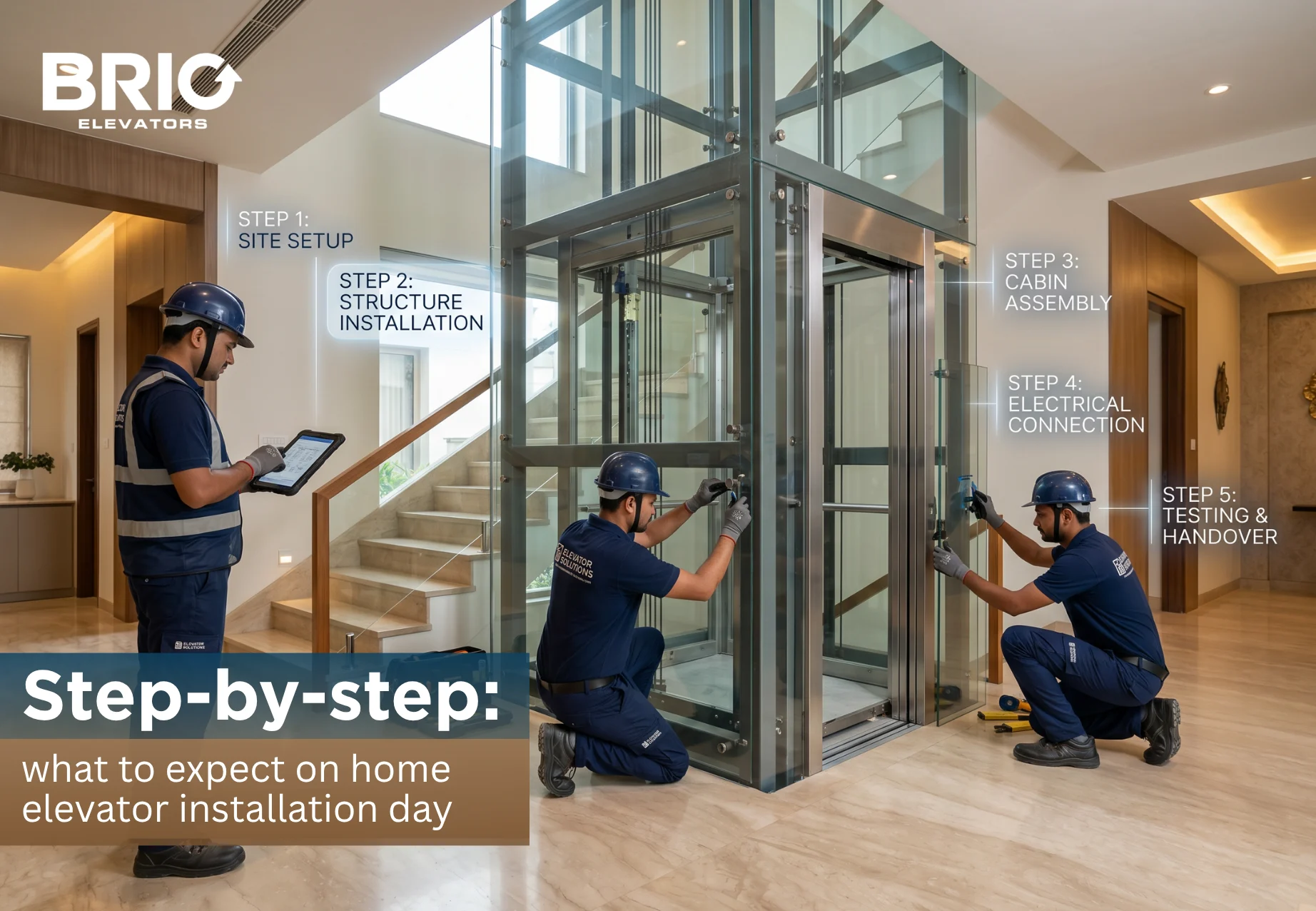
The day has finally arrived. Months of planning, design consultations, and anticipation and today, your home elevator goes in.
But if you've never been through a lift installation before, it's natural to wonder: What exactly happens? Who arrives? How long will it take? Will my home be upside down by evening?
This guide walks you through the entire home elevator installation process — from the moment the Brio team arrives at your door to the moment you take your very first ride. No surprises, no anxiety — just a clear, honest picture of what your installation day looks like.
By the time installation day arrives, a significant amount of work has already happened — and knowing this helps you understand why the on-site process flows as smoothly as it does.
Civil preparation is complete. Your floor openings at each level have been cut, door openings are ready, and the installation zone is clear. This was handled in the days prior to installation day, so the team arriving today isn't starting from scratch; they're arriving at a prepared site.
Your lift has been manufactured and delivered. The components guide rails, cabin panels, drive mechanism, door systems, control panel have been produced to your exact specifications and are either already at your home or arriving with the installation team.
Your electrical connection is ready. A dedicated single-phase circuit with the correct MCB rating has been set up at the installation point by your electrician, as advised by Brio during the pre-installation briefing.
With all of this in place, installation day is focused, efficient, and clean.
Before the team arrives, here's what you should have ready:
This isn't a long list and Brio's team will remind you of all of this during the pre-installation briefing. But having it ready makes the day go smoother for everyone.
Step-by-Step: How Installation Day Unfolds
Morning — First 30–45 minutes
The Brio installation team arrives typically with a trained crew of 2 to 4 technicians depending on the size and complexity of your installation. Before a single tool comes out, the lead technician does a complete walkthrough of the installation site with you.
They'll confirm the floor openings are correctly sized, check that the electrical connection is in place, review the installation plan against your actual space, and flag anything that needs attention before work begins.
This walkthrough is important; it's the team's opportunity to catch any last-minute surprises and yours to ask any questions before the work gets underway.
Step 2: Unboxing and Component Staging
Morning — 45 minutes to 1.5 hours
The lift components are carefully unboxed and organised at the installation site. Guide rails, cabin panels, drive unit, door frames, landing fixtures, control wiring everything is laid out methodically before assembly begins.
This staging step might seem like housekeeping, but it's a critical part of the Brio home elevator setup process. A well-organised site means the assembly flows without interruption, without hunting for parts, and without mistakes.
You'll notice the team working quietly and deliberately here precision over speed.
Step 3: Guide Rail Installation
Mid-morning
The guide rails are the structural spine of your elevator, the vertical tracks along which the cabin travels. These are installed first, anchored securely at each floor level and aligned with precision tools to ensure they are perfectly plumb (straight up and down).
Getting the rails right is the foundation of everything else. Even a small misalignment at this stage affects the ride quality, door operation, and long-term performance of the lift. Brio's team takes the time needed here; it's not a step that gets rushed.
Step 4: Drive Mechanism and Structural Frame
Mid-morning to early afternoon
With the guide rails secured, the drive mechanism, the electric motor and control unit that powers the lift is installed within the structural frame. For the BE 360, this is housed within the octagonal structure itself, making it a compact, self-contained installation.
The structural frame that gives the lift its form the octagonal skeleton in the case of the BE 360 is assembled and connected to the guide rail system. By the end of this step, the skeleton of your elevator is standing in your home.
Step 5: Cabin Assembly
Early to mid-afternoon
The cabin is assembled within the structural frame glass panels, interior walls, flooring, handrails, lighting, and the control panel inside the cabin. This is the step where the lift starts to look like what you saw in the showroom or the brochure.
For the BE 360's panoramic glass cabin, this stage is particularly satisfying to watch the octagonal glass panels go in one by one, and the lift takes on its full character. If you're home during this phase, it's worth a look.
Interior finishes are fitted carefully and inspected as they go in. Scratches or installation damage to panels are caught and addressed on the spot not discovered later.
Step 6: Landing Door Installation
Mid to late afternoon
Landing doors at each floor level through which you enter and exit the lift are installed and aligned at every stop. This includes the door frames, door panels, locking mechanisms, and safety interlocks that prevent the lift from moving unless all landing doors are properly closed.
Door alignment is checked carefully at each floor. The doors must open and close smoothly, latch securely, and trigger the safety interlock correctly every time. This step takes patience and attention and Brio's team brings both.
Step 7: Electrical Wiring and Control System
Late afternoon
With the mechanical structure complete, the electrical wiring is run connecting the drive unit, the cabin controls, the landing call buttons, the safety sensors, and the ARD (Automatic Rescue Device) system.
The control system is the brain of your elevator. It manages every movement, every door cycle, and every safety response. Wiring is done neatly, connections are double-checked, and the control panel is configured to your installation's specific parameters.
Step 8: Safety Testing and Commissioning
Late afternoon to evening
This is the most critical stage of the entire safe home elevator installation in India and the one that takes as long as it takes, without shortcuts.
Brio's team runs the lift through a comprehensive commissioning process:
Only when every check passes does the lift move to handover. This is non-negotiable and it's what gives you the confidence to use your new elevator with complete peace of mind.
Step 9: Handover, Demo, and Documentation
Evening
With commissioning complete, the lead technician walks you through your new elevator. You'll learn:
You'll receive complete documentation including installation records, safety certification, and warranty paperwork. Ask any questions you have here the team is there for this conversation, not rushing to the next job.
A standard two-floor Brio home elevator installation typically takes one full working day roughly 8 to 10 hours from team arrival to handover. Three-floor installations may extend into a second day, particularly if the commissioning phase runs into the evening.
The honest answer to how long does home elevator installation take is: it takes as long as it needs to. Brio's team doesn't cut corners to finish faster. If a rail alignment needs re-checking or a door interlock needs adjustment, that happens before handover not after.
This is often the question homeowners are most anxious about and the answer is reassuring.
The work is contained to the installation zone. Your other rooms, your furniture, your finished surfaces all untouched. The team cleans up the installation area before leaving, removing packaging, dust, and debris.
What you're left with is a clean, finished elevator in your home ready to use, with no construction aftermath to deal with.
The Day in Summary
Installation day is not a day of chaos. It's a day of skilled, methodical work by a trained team who have done this many times before. Your role is simple: be available, have the space prepared, and enjoy watching your home gain something genuinely useful and beautiful.
By evening, you'll press a button, step in, and rise to your upper floor smoothly, quietly, and safely.
That's what the day is for.
Ready to Plan Your Installation?
Brio's team will walk you through every step of the process during a free site visit so by the time installation day arrives, you know exactly what to expect.
📞 Call: +91 9398113939 🌐 Visit: brioelevators.com