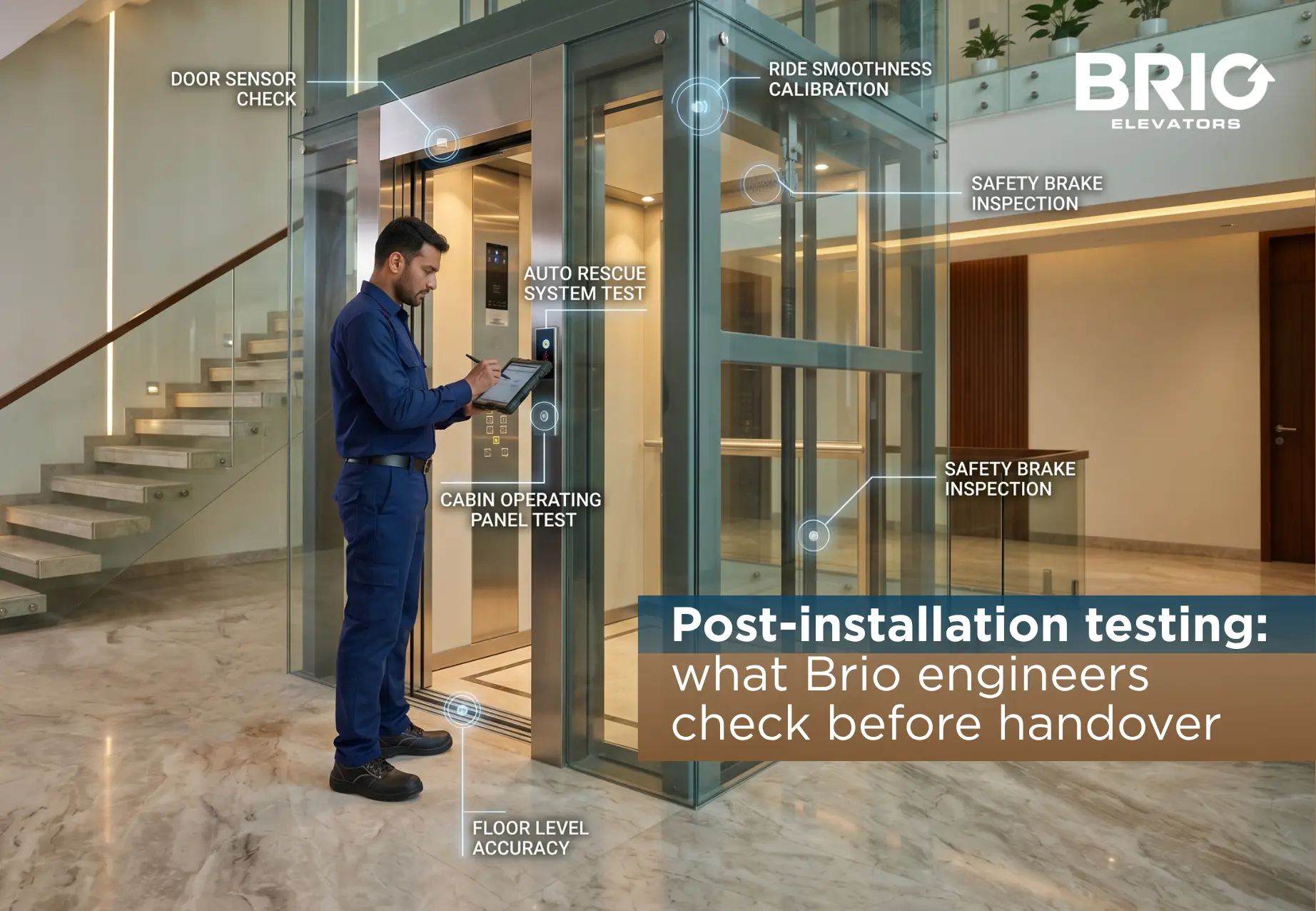
The moment your Brio elevator is installed is not the moment it is handed over to you. Between installation and handover lies one of the most important stages of the entire process post-installation testing. This is where Brio's engineers go through every system, every safety feature, and every performance detail with meticulous precision, ensuring that what enters your home is not just a working elevator, but a perfectly calibrated, fully certified, and deeply reliable one.
For a homeowner who has invested in quality, this stage matters enormously. Understanding what happens during post-installation testing gives you the confidence that your elevator has been held to the highest standard before you ever step inside it.
A home elevator is not a piece of furniture. It carries people your family, your parents, your children. Every component must perform exactly as engineered, every time, under every condition.
At Brio Elevators, post-installation testing is not a formality. It is a disciplined, multi-point process carried out by trained engineers who understand that a home elevator earns its place in a family's life only when it is provably safe, genuinely smooth, and completely dependable.
No Brio elevator is handed over to a homeowner without passing every point on this checklist. That is not a marketing promise it is an engineering standard.
Before we walk through what Brio engineers check, here is what every homeowner should understand about the post-installation phase:
Be present during the final walkthrough. Brio engineers will demonstrate every feature be there to see it firsthand.
Ask questions freely. If something is unfamiliar, ask. You should leave the handover session knowing exactly how your elevator works, including all emergency features.
Ensure all family members are briefed. Seniors, children, and daily users should all understand basic operation before the first independent ride.
Keep your handover documents safe. Your installation certificate, warranty documents, and service schedule form the foundation of your elevator's long-term care.
Register for your Annual Maintenance Contract (AMC) from day one. Post-installation care begins the moment handover ends.
Here is a detailed look at the installation quality check process Brio engineers follow before signing off on every home elevator.
The first step in post-installation testing is verifying that the shaft whether masonry or metal has been installed precisely to specification. Engineers check that all shaft dimensions are aligned with the approved drawings, that the guide rail brackets are correctly positioned, and that there are no structural gaps or misalignments that could affect the elevator's long-term performance.
This is the foundation of everything that follows. A perfectly built elevator inside an imprecisely constructed shaft will not perform the way it should and at Brio, that is never acceptable.
Depending on the model whether it is the belt-driven BE-300, the rope-driven BE-200, the hydraulic BE-100, or the octogonal BE-360 Brio engineers run the drive system through a series of performance checks. These include:
Verifying motor operation under load and no-load conditions. Checking that speed is consistent and within specified parameters at all floors. Confirming smooth acceleration and deceleration without any jerk or vibration. Testing for unusual noise, heat generation, or irregular motor behaviour.
A smooth, quiet ride is one of Brio's defining qualities and this stage ensures that promise is upheld in your specific home, with your specific installation.
One of the most common sources of dissatisfaction in home elevators is door operation and floor levelling. Brio engineers check every door on every floor verifying that doors open and close cleanly, that landing alignment is precise, and that the cabin arrives perfectly flush with each floor level.
Even a small gap between the cabin floor and the landing floor is flagged and corrected before handover. For elderly family members or those with mobility needs, this precision is not a detail it is a safety requirement.
This is the stage that Brio engineers approach with the greatest seriousness. Every safety system on your elevator is individually tested and verified before handover.
Automatic Rescue Device (ARD) tested to confirm that in the event of a power failure, the cabin gently descends to the nearest floor and doors open safely.
Door sensors and multi-beam light curtains verified to confirm they detect obstruction and prevent door closure when any person or object is in the doorway.
Overload sensor tested to confirm the elevator responds correctly when the weight limit is exceeded, alerting the user without allowing the cabin to travel.
Emergency stop confirmed to be operational and immediately responsive.
Pit and over-travel limits checked to ensure the elevator stops precisely within the defined travel range.
Manual lowering and emergency access verified so that trained personnel can safely operate the elevator in any emergency scenario.
Intercom and alarm system tested to confirm clear two-way communication is available from inside the cabin at all times.
Backup battery and UPS confirmed to be functioning and capable of supporting safe operation during a power outage.
At Brio, these checks are not optional. They are the core of the post-installation quality standard and no elevator leaves our engineers' hands until every single one passes.
For homeowners who have opted for Brio's advanced features biometric access, RFID panels, Alexa voice control, or numberpad authentication, each of these systems is tested individually for response accuracy, integration with the elevator's control system, and reliability across repeated cycles.
Your elevator should respond to your voice, your card, or your fingerprint exactly as designed every time. Brio engineers verify this before you ever use it yourself.
A Brio elevator is as much a design statement as it is a functional system. The post-installation quality check therefore includes a thorough inspection of the cabin interior verifying that all finishes, panels, lighting, flooring, and customised elements have been installed to the specified design, that there are no surface defects, and that the overall presentation reflects the standard expected of a premium Brio product.
This matters because the cabin is the space your family inhabits every time they travel between floors. It should look exactly as you chose it to look.
Before handover, Brio engineers run the elevator through a full load test operating it at its rated capacity for a series of continuous cycles across all floors. This test confirms that the elevator performs consistently under real-world conditions, not just in a controlled single-run demonstration.
It also allows engineers to make any final calibration adjustments to ensure ride quality, levelling precision, and door timing are optimised to their finest settings.
Once all checks are completed and verified, Brio engineers compile a full installation quality check report. This document records every test that was conducted, every system that was verified, and any adjustments that were made during the process.
You receive this documentation at handover along with your installation certificate, warranty details, user manual, and AMC schedule. These documents are your long-term reference for every future service interaction, and Brio ensures they are comprehensive, clear, and professionally presented.
At Brio Elevators, handover is not a transaction. It is a moment of trust.
It is the moment when our engineers place the full confidence of their work in your hands. Every test conducted, every system verified, every finishing detail inspected, all of it is in service of one simple commitment that your Brio elevator will perform brilliantly from the very first ride, and every ride that follows.
Our engineers take the time to walk you through your elevator's features, answer every question you have, and ensure your entire household is comfortable and confident with their new home elevator.
Because a home elevator from Brio is not just installed. It is delivered with care, precision, and pride.
Post-installation testing is the beginning of your elevator's story, not the end of Brio's involvement. To keep your elevator performing at the standard it was handed over in, Brio recommends:
A professional service check every six months, conducted by Brio's certified technicians. Immediate attention to any change in ride quality, sound, or door behaviour however minor it may seem. Never exceeding the rated load capacity. Keeping the cabin and door tracks clean and free of obstruction. Enrolling in Brio's Annual Maintenance Contract for priority service, scheduled inspections, and complete peace of mind.
A Brio elevator that is properly cared for will serve your family with the same smoothness and reliability on its thousandth journey as it did on its first.
At Brio Elevators, post-installation testing is the final expression of everything we stand for precision, professionalism, and genuine care for the families whose homes we enter.
We do not hand over an elevator. We hand over confidence.
Contact Brio Elevators today to learn more about our installation process, testing standards, and post-handover care programmes.
📞 Call: +91 9398113939 🌐 Visit: brioelevators.com