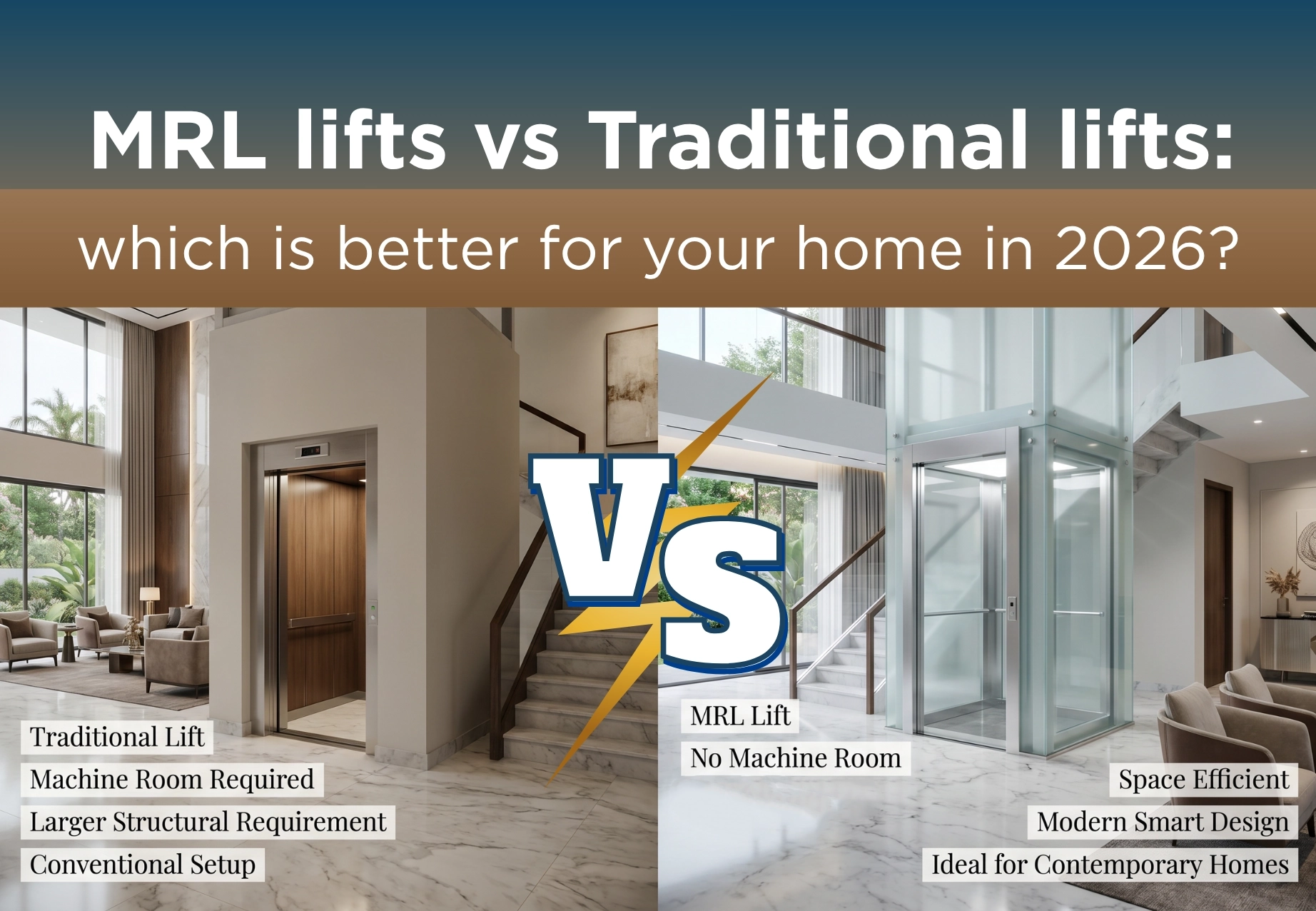
If you are researching home elevators in 2026, one question keeps coming up MRL lift vs traditional lift, which one is actually better for your home?
It is a question worth asking. Because the answer has changed significantly in recent years and if you are building or upgrading your home in 2026, the difference between choosing right and choosing wrong will be felt every single day for the next two decades.
At Brio Elevators, we have made our position clear. We build MRL lifts. Not because it is a trend. Because after years of engineering experience, customer feedback, and a deep understanding of how Indian families actually live in their homes, we are convinced that MRL technology is simply the better way to move between floors.
Here is exactly why.
A traditional lift also known as a machine room lift requires a dedicated mechanical room, typically built above the shaft or adjacent to the top floor. This room houses the motor, gearbox, control panel, and drive system. For decades, this was the only way to build an elevator. The technology was proven, widely available, and accepted without question.
But accepted without question is not the same as genuinely right.
The machine room consumes space. The geared motor consumes energy. The mechanical complexity demands more frequent and more intensive maintenance. And the ride that familiar slight jerk at the start and stop of every journey was simply something people learned to live with.
In an era where homeowners had no better option, traditional lifts were the answer. In 2026, they no longer are.
MRL stands for Machine Room Less. An MRL lift integrates the motor and control systems directly into the shaft eliminating the machine room entirely. The drive mechanism, typically a compact gearless motor, operates within the hoistway itself.
The result is an elevator that takes less space, uses less energy, makes less noise, requires less maintenance, and delivers a noticeably superior ride all within a more elegant, more refined package.
This is not a marginal improvement. It is a fundamental shift in what a home elevator can be. And it is precisely why Brio chose to build exclusively around MRL technology.
A traditional lift demands a machine room. In most Indian homes, independent villas, duplexes, urban residences this means sacrificing four to six square feet of usable space to house machinery. Space that could be a study corner, a storage room, or simply a breathing room in a home where every square foot has been carefully considered.
An MRL lift needs no machine room. None. The shaft is the only space your elevator requires and everything mechanical lives neatly within it.
For the modern Indian homeowner who has spent years planning, building, and perfecting their home, this is not a minor convenience. It is a meaningful reclaiming of space that belongs to you.
Traditional lifts use geared motors older drive technology that consumes significantly more electricity and generates excess heat in the process. Over a year of regular home use, the energy consumption of a traditional geared lift adds noticeably to your electricity bill. Over a decade, it adds substantially.
MRL lifts use gearless motors compact, highly efficient drives that draw far less power. The physics are straightforward fewer mechanical components in the power transmission chain means less energy lost to friction and heat. More of every unit of electricity goes directly into moving the cabin nothing wasted.
In 2026, with electricity costs rising and sustainable living becoming a genuine priority for Indian homeowners, energy efficiency is not a technical footnote. It is a value that matters to the way you live.
This is where the conversation becomes personal.
A traditional geared lift has a characteristic feel a slight jerk as it starts, a noticeable deceleration as it approaches the floor, and a stop that reminds you, every time, that there is machinery at work. Most people who have only experienced traditional lifts assume this is simply how elevators feel.
It is not.
An MRL gearless lift accelerates gently, travels smoothly, and arrives at each floor with a precision and softness that feels entirely effortless. There is no jerk. There is no vibration. There is simply a seamless transition from one floor to the next so smooth that first-time riders often pause to remark on it.
For families with elderly parents, this is not an aesthetic preference. A smoother ride is a safer, more comfortable, more dignified experience. For children, it is the difference between an elevator that feels slightly unsettling and one that feels completely natural.
A traditional lift with a machine room is present in the acoustic environment of your home. The motor hum, the mechanical movement, the sound of the gearbox travels through the structure of the building and becomes background noise that everyone simply adapts to.
An MRL lift with a gearless motor is genuinely quiet. Operating within an enclosed shaft, with no separate machine room generating ambient noise, a Brio elevator is something you hear only when you are standing next to it and even then, barely.
In a home where atmosphere matters, where evenings are quiet, where conversations are unhurried, where the feeling of the space has been carefully cultivated a silent elevator is not a luxury. It is a natural extension of the way you live.
Here is where many comparisons mislead by focusing only on upfront cost and ignoring the total cost of owning an elevator over its lifetime.
A traditional lift may have a lower initial price point in some cases. But that number tells only part of the story.
Higher monthly electricity consumption adds up every year. More intensive maintenance requirements gearbox servicing, machine room upkeep, oil changes for geared systems cost more over time. The machine room represents a permanent space cost in your home. And the shorter effective lifespan of geared mechanical systems means earlier replacement or major overhaul.
An MRL lift costs more thoughtfully upfront investment in superior technology that pays back through lower running costs, simpler maintenance, longer operational life, and the daily quality of the experience it delivers.
For a homeowner who thinks in decades and a home elevator should always be considered over decades, not years the MRL lift is the more financially intelligent choice. Not just the better engineered one.
For any Indian homeowner building or renovating a home in 2026 a villa, a duplex, a multi-storey residence, or an existing home being upgraded an MRL lift is the only choice that makes complete sense.
It respects your space. It respects your budget over time. It respects the atmosphere of your home. And it respects the people who use it every day delivering a ride quality that never lets you down.
Traditional lifts served their era well. That era has passed.
If the question is which home lift is best in India in 2026, the answer is one that combines European engineering standards with a genuine understanding of Indian homes, Indian climates, and Indian families.
Brio Elevators India's first Indo-Italian home elevator company builds exclusively to that standard.
In 2026, the best home lift in India is the one that was built for exactly this moment and for the next twenty years of your family's life.
BE-300 Gearless belt-driven MRL elevator. Ultra-slim, ultra-silent, and available in the widest range of cabin customisation options. The ideal choice for modern homes, retrofits, and design-conscious homeowners who want an elevator that complements their interiors perfectly.
BE-200 Gearless rope-driven MRL elevator certified under European safety standards. Equipped with biometric and RFID access, multi-beam light curtains, and advanced safety systems. For homeowners who demand the absolute highest standard in engineering, in safety, and in experience.
BE-360 India's first hybrid hydraulic Octogonal elevator with 360° cabin views. A statement piece for villas and penthouses where the elevator itself is part of the architecture.
BE-100 Premium hydraulic home lift built with German engineering and manufactured in Italy. Whisper-quiet, minimal maintenance, backed by a five-year warranty. The choice for families who want effortless, reliable comfort that lasts.
All Brio models are available in masonry and metal shaft configurations for new constructions and existing homes alike.
No machine room every square foot of your home stays yours.
Lower energy consumption quieter on your electricity bill, lighter on the environment.
Superior ride quality smooth, silent, and precise at every floor.
Simpler maintenance fewer components, less servicing, lower long-term cost.
Better total value smarter investment over the full lifetime of your elevator.
Every home is different. Every family has different needs, different spaces, and different visions for the life they want to live. At Brio Elevators, we begin every conversation by listening because the right elevator for your home is the one that fits your life, not just your shaft dimensions.
Our team will visit your Site, assess your space, and guide you to the Brio MRL model that is genuinely right for you with complete transparency, honest advice, and the confidence of a team that has done this in thousands of homes across India.
🌐 Visit: brioelevators.com
Q1. What is an MRL lift?
MRL stands for Machine Room Less. It is an elevator that requires no separate machine room all mechanical components sit within the shaft itself, saving space and delivering a quieter, more efficient ride.
Q2. Is MRL lift better than traditional lift?
Yes for most modern homes, MRL lifts are the smarter choice. They consume less energy, operate more quietly, require less maintenance, and save valuable space by eliminating the machine room entirely.
Q3. Can MRL lift be installed in an existing home?
Absolutely. MRL lifts are ideal for retrofit installations. With Brio's metal shaft solution, the process involves minimal civil work and significantly less disruption to your existing home.
Q4. Why does Brio only offer MRL lifts and not traditional lifts?
Because we believe in recommending only what genuinely serves our customers and after years of installation experience, customer feedback, and deep engineering knowledge, we are convinced that MRL technology is simply the better choice for the modern Indian home in every meaningful way. Space efficiency, energy consumption, ride quality, noise levels, maintenance simplicity MRL leads on every dimension that matters to a homeowner living with their elevator every day. We do not offer traditional lifts because we do not believe they are the right answer for the homes we build for.
Q5. Is MRL lift safe for elderly and children?
Yes. Brio MRL elevators are equipped with automatic rescue devices, multi-beam light curtains, overload sensors, emergency intercoms, and backup battery systems making them completely safe for every member of the family.