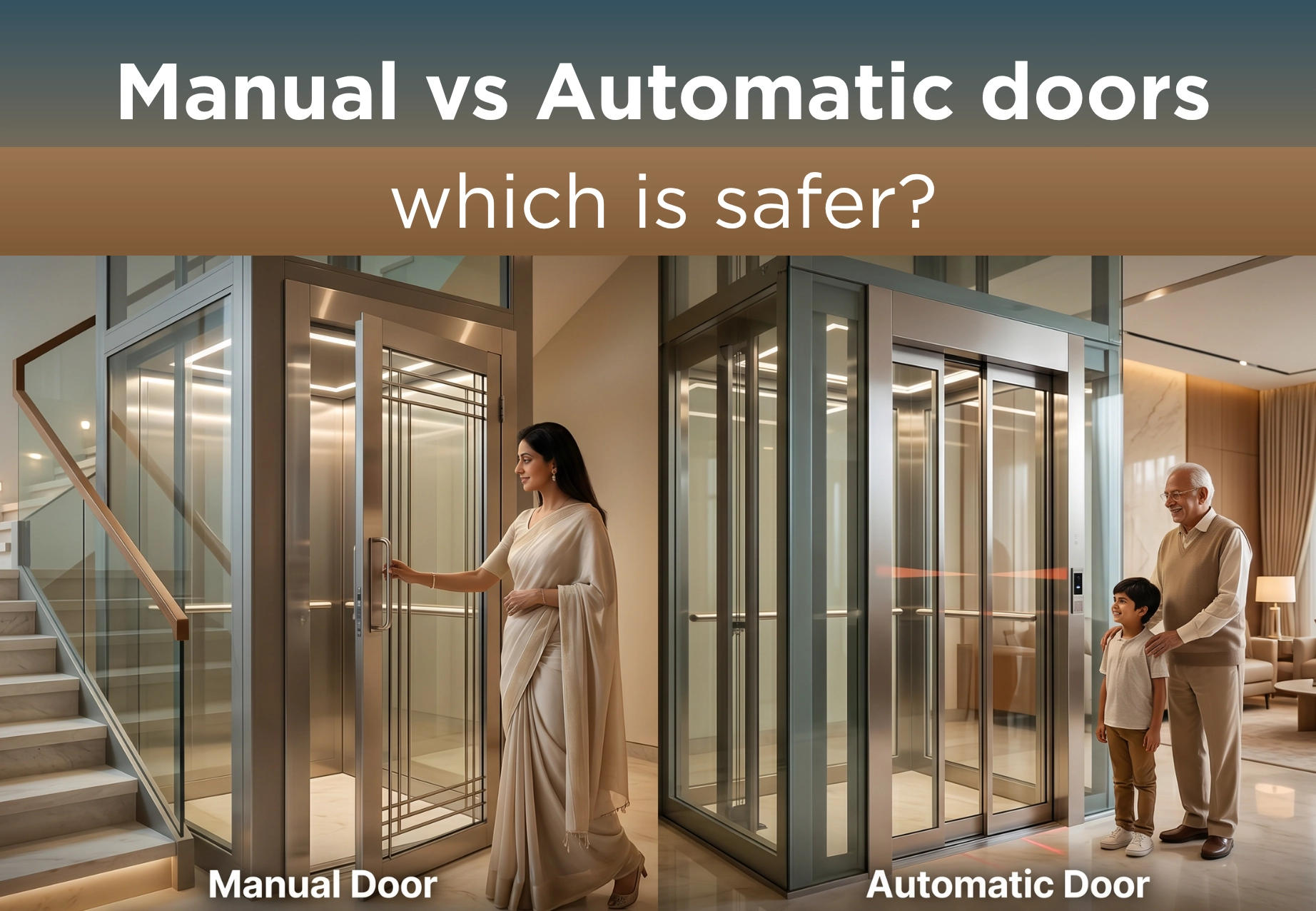
When homeowners think about home elevator safety, they think about the drive system, the emergency rescue device, the backup battery. What they rarely think about until someone asks the question directly is the door.
Yet the door is the single most frequently used component of your home elevator. Every journey begins with a door opening and ends with a door closing. Over the lifetime of a home elevator, that door will operate thousands of times in the hands of elderly parents, curious children, and every other member of your household.
So when it comes to manual vs automatic doors on home elevators which is actually safer? Which door type genuinely protects your family better? And which is the right choice for your home?
This blog answers all of it clearly, honestly, and completely.
In a home elevator buying decision, the door rarely gets the attention it deserves. Homeowners spend considerable time choosing cabin finishes, drive technology, and smart features and then accept whatever door type is offered without questioning it deeply.
That is a mistake.
The door is the boundary between safety and risk every single time the elevator is used. It is the component most likely to interact with a person, a hand reaching in, a child standing too close, an elderly parent moving slowly. And it is the component whose failure, however unlikely, has the most immediate consequences.
Understanding the difference between manual and automatic doors is therefore not a technical detail. It is a safety decision. And in any serious home elevator door safety conversation, it deserves to be treated as one.
A manual elevator door is exactly what it sounds like a door that requires the user to physically open and close it before the elevator can move.
In the residential elevator context, manual doors were the original standard. They are mechanically simpler, less expensive to produce, and require no electrical actuation system. The user opens the door, steps in, closes the door, and then operates the elevator.
Manual doors are still found in some older residential elevator installations and in certain entry-level home lift products available in the Indian market today.
They function. But functioning and being genuinely safe for a modern Indian home are two very different things.
An automatic elevator door opens and closes without any physical effort from the user. Powered by an electric motor and controlled by the elevator's central system, automatic doors respond to floor calls, passenger entry, and departure opening when the cabin arrives at a floor and closing automatically before the elevator travels.
Automatic doors are the global standard in residential elevator safety. They are what you find in every premium home elevator including every model in the Brio range.
But the mechanism is only part of the story. What makes automatic doors genuinely superior is not just that they open and close on their own. It is the intelligence built into that process, the sensors, the safety interlocks, and the protective systems that ensure every door operation is safe, every single time.
When comparing manual vs automatic doors on a home elevator, safety is not one consideration among many. It is a consideration.
A manual door places the entire responsibility of safe door operation on the user. If the door is not fully closed, the elevator should not move but in manual systems, the enforcement of this depends on mechanical interlocks that are simpler and less sophisticated than the electronic safety systems in automatic doors.
More importantly, a manual door offers no protection against the door being opened mid-journey, no sensor to detect an obstruction, and no intelligent response to an unsafe situation. It does exactly what the person operating it tells it to do nothing more.
An automatic door is fundamentally different. It does not simply open and close. It thinks before it acts.
Brio's automatic door systems are equipped with multi-beam light curtain sensors that scan the entire door opening before every closure. If any person, object, or obstruction is detected in the doorway, the door stops immediately and reverses. No manual door can do this. No mechanical interlock can replicate it.
For a home with elderly parents who move slowly, with children who are unpredictable, or with any family member who uses the elevator independently this intelligence is not a luxury. It is essential.
Brio's Position: We do not offer manual doors. Not because they are unavailable but because we do not believe they meet the safety standard that a Brio home elevator is built around. Every door on every Brio elevator is automatic, sensor-equipped, and safety-interlocked. That is not a product feature. It is a principle.
Understanding home elevator door safety at a deeper level means understanding what the safety systems in an automatic door actually do and why each one matters.
Multi-beam light curtains project an invisible grid of infrared beams across the door opening. The moment any beam is interrupted by a hand, a foot, a walking stick, or a child's toy the door halts and reverses. This system operates in milliseconds. It does not wait for pressure. It responds to presence.
The door interlock system ensures the elevator cannot travel unless every landing door and cabin door is fully and properly closed. This is not a suggestion, it is a hard electrical interlock. The elevator is physically incapable of moving with an open door.
Obstruction detection goes beyond the light curtain monitoring door motor resistance and responding to any unexpected force on the door panel during operation.
Soft close mechanism ensures doors close with a controlled, gentle force never slamming, never catching. For elderly family members and young children, this matters enormously.
Together, these systems create a door that is not just automatic it is actively protective. It is working to keep your family safe every single time it operates.
If the question is which elevator door is best for home, the answer is unambiguous automatic, sensor-equipped doors. Every time. For every home. For every family.
Here is why the answer is so clear.
Ease of use Automatic doors require no physical effort. For elderly family members, for anyone carrying groceries or luggage, for children travelling independently the door simply opens and closes as it should. There is nothing to remember, nothing to force, nothing to get wrong.
Consistency: A manual door is only as safe as the person operating it. An automatic door is equally safe for every user, every time regardless of age, mobility, or attention.
Independence Automatic doors allow every member of the family to use the elevator independently and safely. For homes where the elevator serves elderly parents or family members with mobility limitations, this independence is deeply meaningful. It is what an elevator is ultimately for.
Future-proofing Your family's needs will change over time. The child who uses the elevator today will be a teenager tomorrow. The parent who is fully mobile today may need more support in a decade. Automatic doors serve every version of your family today and in the years ahead.
At Brio, automatic doors are not an upgrade. They are the standard on every model, at every level, in every home we install.
In the Indian residential elevator market, home lift door types vary considerably particularly at the entry-level and mid-range segments where cost pressure sometimes leads to compromises that should never be made on safety.
Here is what Indian homeowners should understand about the door landscape.
Collapsible gate doors still found in some older and lower-cost elevator products in the Indian market. These manually operated, lattice-style gates offer minimal safety protection and are not suitable for homes with elderly members or children. They are a technology from a different era and they belong there.
Manual swing doors a step above collapsible gates but still dependent entirely on the user for safe operation. No sensors. No intelligence. No active protection.
Automatic sliding doors the contemporary standard for residential elevators in India and globally. Electrically actuated, sensor-equipped, and safety-interlocked. The only door type that meets the safety expectations of a modern Indian family.
Automatic telescopic doors a variation of the automatic sliding door that uses two or more panels moving simultaneously to maximise the clear opening width while minimising the space required for door travel. Ideal for homes where cabin width is a consideration.
At Brio Elevators, we offer automatic sliding and telescopic door configurations across our full range because we believe that home lift door types in India should be held to the same standard as the best residential elevator markets anywhere in the world.
No section of a home elevator door safety discussion is more important than this one because the people most affected by door safety in a home elevator are the ones least able to protect themselves.
Elderly parents: For a senior family member using the elevator independently, the difference between a manual and automatic door is the difference between a confident daily experience and a source of anxiety. Slow movement, reduced grip strength, and reduced reaction time all make manual doors a genuine risk. Automatic doors with soft-close mechanisms and full sensor protection give elderly users the dignity of complete independence safely.
Young children: Children are unpredictable near moving components. They reach, they linger, they do not always understand the boundary between safe and unsafe. Multi-beam light curtains that detect any presence in the doorway are not an optional feature in a home with children. They are the minimum acceptable standard.
Family members with mobility needs: For any family member using a wheelchair, a walker, or any mobility aid, automatic doors that open fully and close gently are essential to a safe and dignified elevator experience.
At Brio, every elevator we install is used by real families with elderly parents, with children, with the full range of human need and human unpredictability. Our door systems are designed with all of them in mind.
The answer to the manual vs automatic doors home elevator question is clear at Brio and it has always been clear.
We do not offer manual doors because we do not believe they belong in a home that has been built with care. A home elevator is a long-term addition to a space that your family relies on every day. The door of that elevator interacts with your family more than any other component. It should be the safest, most intelligent, most carefully engineered element of the entire system.
Automatic doors equipped with multi-beam sensors, soft-close mechanisms, full interlocking safety systems, and elegant engineering are the only doors that meet that standard.
At Brio, safety is never where we cut corners. It is where we start.
At Brio Elevators, the door is not an afterthought. It is an experience.
Every Brio door opens with a quiet, confident slide. Every sensor operates invisibly without announcing itself. Every closure is soft, precise, and complete. And behind every door is a safety architecture that has been engineered, tested, and verified to the highest international standards.
When a Brio door opens, it says welcome. When it closes, it says you are safe.
That is the standard every home elevator door should meet. And at Brio, it is the only standard we build to.
Yes completely and without exception. Automatic doors with multi-beam sensors, soft-close mechanisms, and full safety interlocks offer a level of active protection that no manual door can replicate.
Automatic sliding or telescopic doors with sensor protection and soft-close mechanisms. They require no physical effort, respond intelligently to slow movement, and allow complete independent use safely and with dignity.
In a properly engineered elevator no. Brio's door interlock system makes it physically impossible for the elevator to travel unless every door is fully and correctly closed.
The main types are collapsible gates, manual swing doors, automatic sliding doors, and automatic telescopic doors. Brio offers only automatic sliding and telescopic doors, the safest and most refined options available.
Automatic doors with multi-beam light curtains without question. The sensor system detects any presence in the doorway and immediately halts and reverses the door. It is the only door type that actively protects children who may linger or reach near the door opening.
Book your complimentary home assessment today and let our team show you what genuinely safe, beautifully engineered automatic elevator doors look and feel like in a home just like yours.
📞 Call: +91 9398113939 🌐 Visit: brioelevators.com