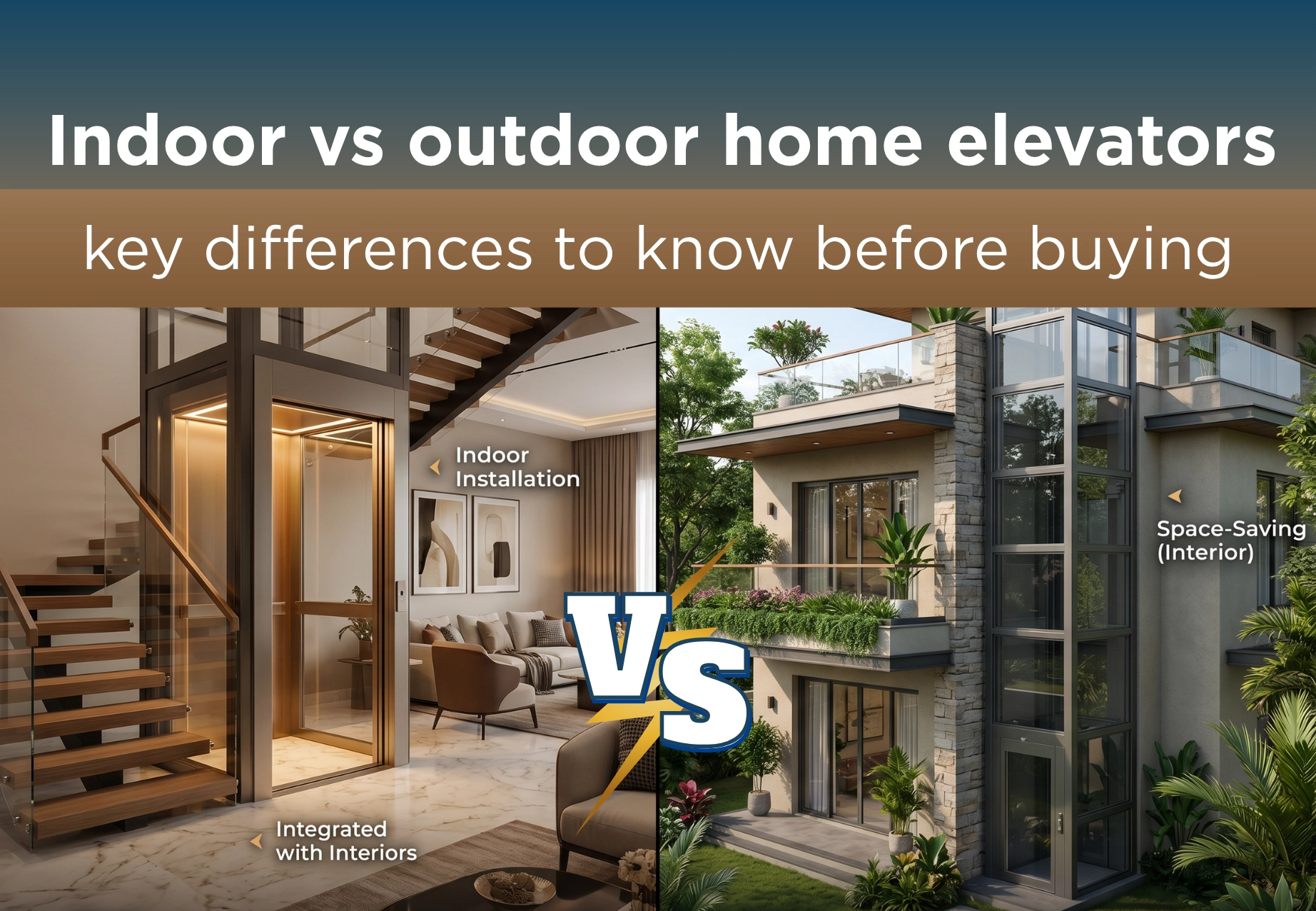
When most people picture a home elevator, they imagine it tucked neatly inside the house alongside the staircase, in a corner of the living room, or rising through the centre of an open-plan space.
But not every home is built that way. Older independent houses, sprawling bungalows, farmhouses, and certain villa designs sometimes make an outdoor installation the more practical or more attractive option. A lift on the exterior facade, rising alongside the building, accessible from an open terrace or a covered porch.
Both configurations work. But they are fundamentally different products, with different engineering requirements, different installation considerations, and different long-term implications for your home.
If you're researching the indoor vs outdoor home elevator India decision, this guide gives you the complete picture so you buy the right lift for the right location.
An indoor home lift is installed within the envelope of your home inside the building's walls, typically in a dedicated shaft space, a corner, or alongside an existing staircase.
This is the most common configuration for home elevators in India. The lift operates within a climate-controlled, sheltered environment, protected from the elements by the building itself.
Typical indoor installation locations:
A residential outdoor lift India is installed on the exterior of a building mounted on the outer facade, in an exterior courtyard, or on an open terrace structure. The lift travels up the outside of the home, with landings accessible from balconies, terraces, or exterior doors at each floor.
Outdoor lifts are less common in India but are a practical solution in specific scenarios particularly for homes where the interior layout cannot accommodate a lift shaft, or where the architectural design lends itself to an exterior installation.
This is the most fundamental difference between an indoor and outdoor home elevator and the one that drives the most significant differences in engineering, cost, and maintenance.
An indoor home lift installation India operates in a protected environment. Temperature fluctuations are moderate, humidity is controlled, and the lift is never exposed to direct rain, sunlight, or dust. Standard materials and finishes perform well over long periods.
An outdoor home elevator India faces everything the Indian climate throws at it and the Indian climate is unforgiving. Depending on your location:
For an outdoor installation to perform reliably over years and decades, every component must be specified for outdoor use:
An outdoor lift without this level of specification will deteriorate. Not when. The difference between a well-specified outdoor lift and a poorly specified one isn't visible on the day of installation. It becomes visible in year three, year five, and year seven.
2. Civil and Structural Requirements
Indoor installations typically work within the existing structure of the home. Civil work involves floor openings at each level, door openings in interior walls, and (for pit-free systems like Brio's) no excavation below ground level. The home's existing walls and slab provide the structural context.
Outdoor installations require additional structural consideration:
The civil and structural work for an outdoor installation is generally more complex than for an indoor one and must be done by engineers and contractors who understand the specific demands of exterior structures in Indian climatic conditions.
3. Aesthetics and Design Integration
An indoor home elevator, when thoughtfully designed, becomes part of the home's interior architecture. The Brio BE 360's panoramic glass cabin, for instance, adds a visual feature to the interior, a design element that enhances the space around it.
An outdoor lift presents a different design challenge: it must look intentional on the exterior of the building, not like an afterthought bolted onto the facade. When done well with materials and finishes that complement the building's exterior design an outdoor lift can be genuinely striking. When done poorly, it looks industrial and out of place.
The best outdoor residential lifts use clean, contemporary enclosure designs in materials that age well outdoors powder-coated aluminium, stainless steel, and glass and are specified to complement the building's exterior colour palette and finish.
4. Maintenance Requirements and Frequency
All elevators require regular maintenance. But outdoor lifts require more of it and more specialised servicing.
Indoor lifts in a sheltered environment have relatively predictable maintenance needs: routine inspection of mechanical components, lubrication of moving parts, electrical system checks, and door alignment verification. A standard AMC (Annual Maintenance Contract) covers these comfortably.
Outdoor lifts face additional maintenance demands:
Factor this into your total cost of ownership calculation. An outdoor lift may have a similar installation cost to an indoor one, but its annual maintenance cost over a decade can be meaningfully higher particularly in coastal or high-rainfall locations.
5. Energy Consumption and Performance
In practical terms, modern electric drive systems perform comparably indoors and outdoors in terms of energy consumption. The motor doesn't care whether it's inside or outside.
However, outdoor lifts in extreme temperature environments particularly in regions where summer temperatures regularly exceed 42–45°C can experience reduced performance efficiency from their electrical and electronic components if these are not rated for high-temperature operation. Ensure that the control system and drive electronics are rated for the ambient temperature range of your specific location.
6. Safety Considerations
Both indoor and outdoor lifts must meet the same fundamental safety standards. However, outdoor installations require additional safety attention in specific areas:
Slip resistance — Landing surfaces at each outdoor floor level must be slip-resistant, particularly in wet conditions. Smooth or polished landing surfaces are a hazard in the rain.
Lightning protection — In areas prone to electrical storms, an outdoor metallic lift structure should be incorporated into the building's lightning protection system.
Wind loading — In exposed locations or on high-rise homes, the lift structure and its anchoring must be engineered to withstand wind loads, including the elevated wind pressures experienced during storms and cyclones in coastal regions.
Lighting — Outdoor lift landings need adequate weather-resistant lighting for safe use after dark.
Here's a practical decision framework for the home elevator buying guide India question of indoor vs outdoor:
Choose an indoor installation if:
Consider an outdoor installation if:
The honest truth is that for the majority of Indian homes, independent houses, duplexes, villas, and apartments an indoor installation is the more practical, more protected, and lower-maintenance choice. Outdoor lifts are the right answer for specific situations, not the default option.
Brio's home elevators are primarily designed for indoor installation and this is a deliberate choice. The BE 360 and BE 300 are engineered to integrate into Indian homes as seamlessly as possible, with pit-free systems, minimal civil work, and designs that complement interior spaces.
For homeowners exploring outdoor options, Brio's team can assess whether an outdoor configuration is feasible for your specific home and location and be honest about whether it's the right choice given your climate, your building, and your long-term maintenance expectations.
That conversation starts with a free site visit. No obligation, no sales pressure, just the right answer for your home.
📞 Call: +91 9398113939 🌐 Visit: brioelevators.com