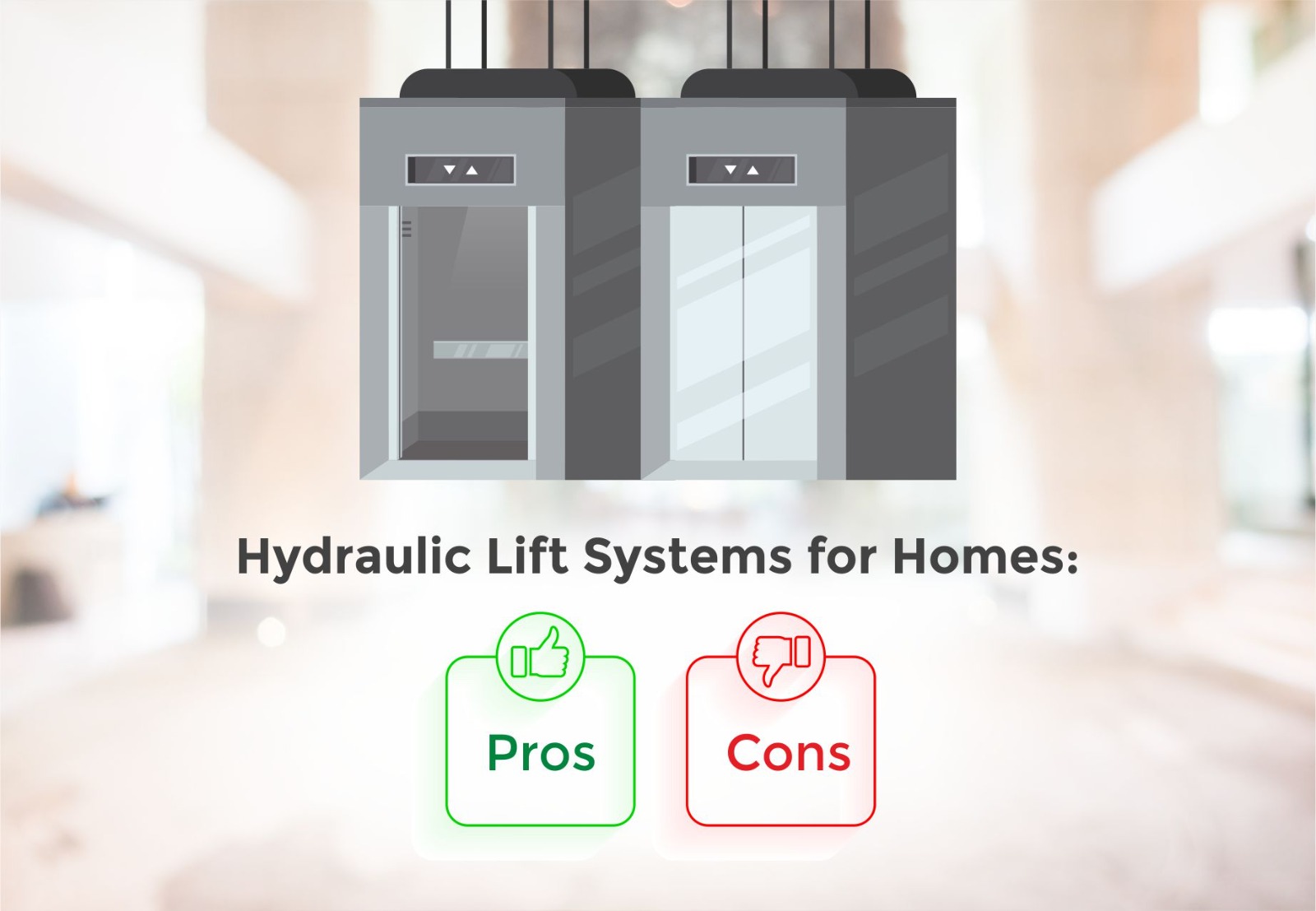
You’ve heard the gentle hum. You’ve seen the sleek glass shaft rising discreetly through a luxury duplex. And maybe, just maybe, you’ve imagined having that same convenience in your own home. Whether you’re building your dream villa, helping aging parents move comfortably between floors, or just looking to add value and accessibility to your home—a hydraulic lift might be exactly what you need.
In this guide, we’ll help you decode everything about hydraulic lift systems for homes. From how they work, to their real-life pros and cons, estimated costs in 2025, and even a brand spotlight—this isn’t just another dry technical article. It’s your down-to-earth guide to making an informed decision, without the jargon.
Let’s break it down simply.
A hydraulic lift operates using the power of fluid mechanics. There’s a hydraulic cylinder, usually filled with oil, that gets pressurized by a pump. As fluid gets pushed into the cylinder, the piston moves up, lifting the elevator car. No steel cables. No heavy counterweights. Just controlled pressure doing the heavy lifting.
And when it's time to come down? Gravity does most of the work. The fluid is slowly released, and the car glides downward gently.
This simplicity in design makes hydraulic lifts incredibly smooth, reliable, and often more compact than rope-based systems—especially valuable in Indian homes where retrofitting space is at a premium.
Imagine gliding up a floor without the faintest jolt. That’s the magic of hydraulic systems. Unlike traction lifts that may occasionally jerk or shudder, hydraulic lifts offer a seamless, spa-like ride between floors. Especially useful when transporting the elderly or kids.
No need for a towering machine room or counterweight shaft. Most modern hydraulic systems require just a shallow pit (200–300 mm) and a small machine room, often accommodated in a utility space or outside wall. That makes it ideal for renovations and existing homes.
Hydraulic lifts have fewer moving parts than their traction counterparts. This means fewer breakdowns, less wear and tear, and lower maintenance costs. An annual service is usually enough to keep the system in perfect working order.
In India, hydraulic lifts tend to be more affordable upfront compared to advanced traction systems. You’re looking at a starting range of around 15 lakhs and going up to ₹17 lakhs for premium 3-floor models. That makes them an attractive option for homeowners on a tight budget but unwilling to compromise on comfort.
The motor and pump unit can be placed away from your main living area—say, in a small machine room or garage. The result? A nearly silent ride, with only the faintest hum (if any) reaching your ears.
Hydraulic lifts aren’t built for speed. With average speeds of 0.10 to 0.15 m/s, they’re slower than traction lifts. If you’re planning to zip up five floors in 10 seconds flat, this might not be your best bet. But if comfort > speed, it’s a worthy trade-off.
While hydraulic systems don’t need constant care, the hydraulic fluid does degrade over time. It may need to be topped off, filtered, or changed after several years—especially in high-use households. Plus, although rare, leaks can be messy and require professional handling.
Despite being space-savvy, you still need to account for a pit below the lift shaft (for the cylinder’s stroke) and a small machine room to house the motor and pump. This might require civil modifications, especially in homes that weren’t initially built to accommodate a lift.
Hydraulic systems use more power to lift than lower, since there’s no energy-recovery mechanism. If you’re extremely eco-conscious or operating off-grid, this might factor into your decision.
Hydraulic lifts aren’t a one-size-fits-all solution—but for many Indian homes, they’re a near-perfect match. Here’s who’ll benefit most:
Here’s a snapshot of what you can expect to spend on a hydraulic lift system for your home in 2025. Prices may vary based on location, civil work, customizations, and installation complexity.
| Model Tier | Model Tier | Price Range (INR) |
| Entry-Level | Up to 2 Floors | ₹14 L – ₹16 L |
| Mid-Range | Up to 3 Floors | ₹15 L – ₹18 L |
| Premium | Up to 4 Floors | Check for Feasibility |
These prices typically include standard installations and basic cabin finishes. Custom designs, glass walls, wood interiors, or smart controls may add to the final quote.
If you’ve been researching hydraulic lifts for Indian homes, Brio likely came up in your search—and for good reason. Brio has positioned itself as a brand that fuses European-quality engineering with Indian practicality. Here’s what sets it apart:
Brio’s hybrid hydraulic tech ensures you glide silently between floors. Perfect for homes where peace is a premium.
No need to dig deep. Brio systems are retrofit-friendly, requiring minimal pit depth and a tiny machine room. You won’t need to rebuild half your home to install one.
Match your elevator cabin to your interior theme—steel, glass, wooden textures, and more. It becomes a part of your decor, not just a utilitarian box.
Comes with a standby mode, ensuring low power draw when not in use—something most older systems don’t offer.
Dust? Humidity? Heatwaves? Brio components are IP-rated and weather-tested to handle India’s diverse climates.
“We installed the Brio hydraulic lift in our duplex in Bangalore last year. Not only is it smooth and silent, but the custom finish also blends perfectly with our interiors. The team was professional from start to finish.”
– Ritika & Ankur Shah
“Brio’s customer service really sets them apart. They walked us through every step and delivered exactly what they promised.”
– Amitabh Rao, Chennai
Ask yourself these three questions:
✅ Do you value ride comfort over lightning-fast speeds?
✅ Do you have room for a shallow pit and compact machine room?
✅ Do you prefer a low-maintenance, long-term solution?
If you said yes to all of the above, a hydraulic lift is likely your perfect match. For homes that value simplicity, elegance, and comfort—it’s hard to go wrong with this system.
As Indian homes evolve to become more accessible, aesthetic, and future-ready, hydraulic lifts are stepping up to meet that demand. They’re compact, smooth, and smartly priced—offering a balance that makes them suitable for urban homes, especially where aging in place and multi-generational living are growing trends.
So if you’ve been weighing the idea of installing a lift in your home, don’t let complexity or cost hold you back. With the right partner, it’s easier and more achievable than ever.
Ready to explore how a hydraulic lift can enhance your home?
Brio Elevators specializes in residential hydraulic systems tailored for Indian families. Let’s schedule a free site visit, walk you through cabin options, and craft a personalized quote that fits your space and budget.
📞 Call us: +91 9398113939
📧 Email: info@brioelevators.com
🌐 Visit: www.brioelevators.com
Elevate your home. Smoothly. Quietly. Reliably.